
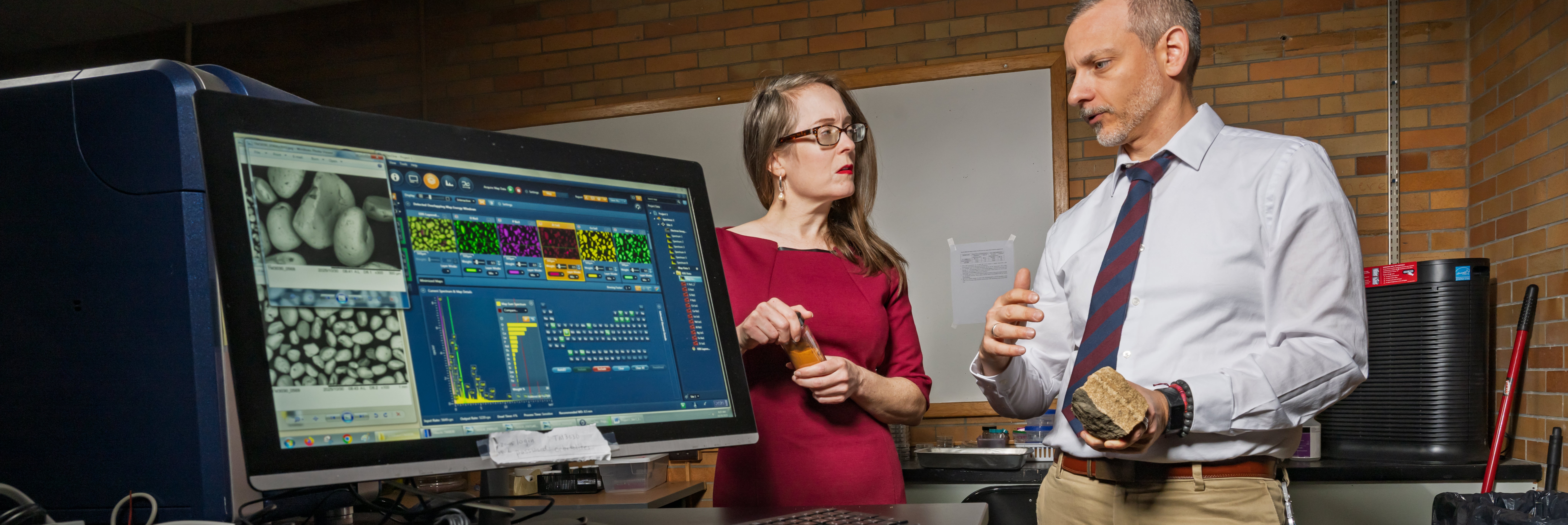
When acid mine drainage spills into streams and rivers, the impacts can be long-lasting and severe—acidic waters, elevated metals and damaged ecosystems that persist for decades. Addressing those challenges is at the heart of a new National Science Foundation–funded project led by Kent State University Associate Professor of Science Education Bridget Mulvey and Earth Sciences Professor David Singer.
Mulvey and Singer are co–principal investigators on a three-year, $833,000 NSF grant that examines how rock type, weathering processes and hydrologic conditions control the release and movement of metals—including rare earth elements and yttrium—from weathered rocks. “Rare earth elements are essential for hundreds of technologies people rely on every day,” Singer said. “Understanding how and why they’re released into the environment not only matters for ecosystem health, but also for thinking more broadly about resource recovery and sustainability.”

The research team will conduct field monitoring and laboratory analyses on rock samples, mine drainage water and stream sediments from abandoned mine sites in Eastern and Southeastern Ohio, where acid mine drainage continues to affect waterways throughout the Appalachian region.
“Acid mine drainage is a major environmental issue in Appalachian Ohio, but it’s also an opportunity to deeply understand how geology and water interact to control water quality,” Singer said. “By studying the rocks, the water and the sediments together, we can start to explain why certain mine sites are much more chemically reactive than others.”
The aim is to understand why some mines release far higher concentrations of metals than others and translating that science into meaningful educational experiences.
Mulvey’s role centers on the project’s education, workforce development, and science mentorship efforts. A central component of the grant emphasizes engaging teachers and students directly in the scientific process, with the goal of building science literacy and expanding awareness of STEM career pathways.
This summer, Singer and Mulvey will facilitate a two-week research experience for five high school teachers, immersing them in fieldwork, laboratory methods and data interpretation connected to the acid mine drainage project. Together, Mulvey and the teachers will develop classroom-ready educational resources and lesson plans that incorporate real project data, scientific practices, and career exploration.

During the following academic year, those teachers will implement the lessons in their classrooms, helping students better understand how scientific research works and how environmental science connects to real-world challenges in Ohio and beyond. In the summer of 2027, the project will expand further when high school students themselves will work alongside Kent State scientists to acquire research experience.
Mulvey also is researching and supporting effective mentorship throughout the project, evaluating how high school teachers, student-scientists, and faculty mentors learn from one another. Her work will focus on strengthening mentorship structures that support scientific learning and professional development.
By pairing cutting-edge research with hands-on education, Mulvey’s leadership ensures the NSF-funded project will have lasting impacts beyond new scientific knowledge. The work aims to improve the understanding of acid mine drainage in Appalachian Ohio, inform future remediation strategies and inspire the next generation of scientists to tackle complex environmental problems.
“We want teachers and students to feel like they are part of the scientific community,” Mulvey said. “That means giving them authentic research experiences, supporting strong mentorship and helping them see how environmental science careers can make a real difference in people’s lives.”