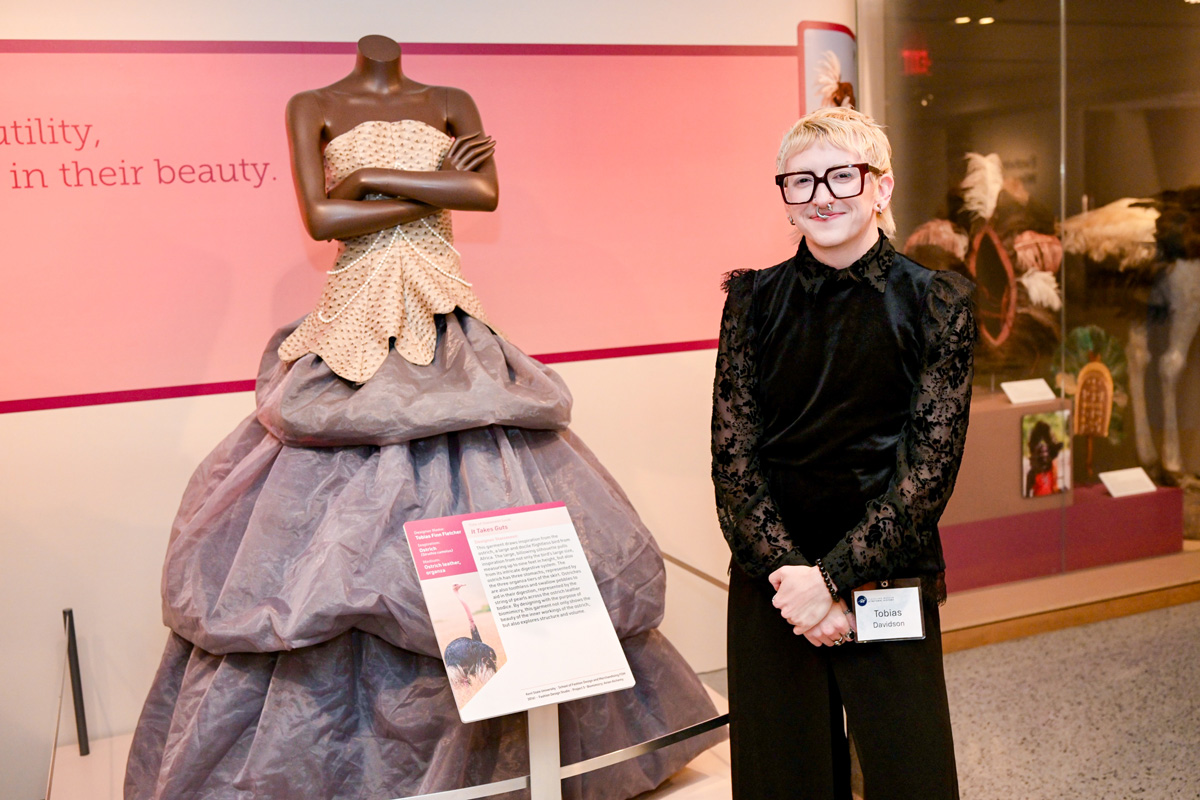
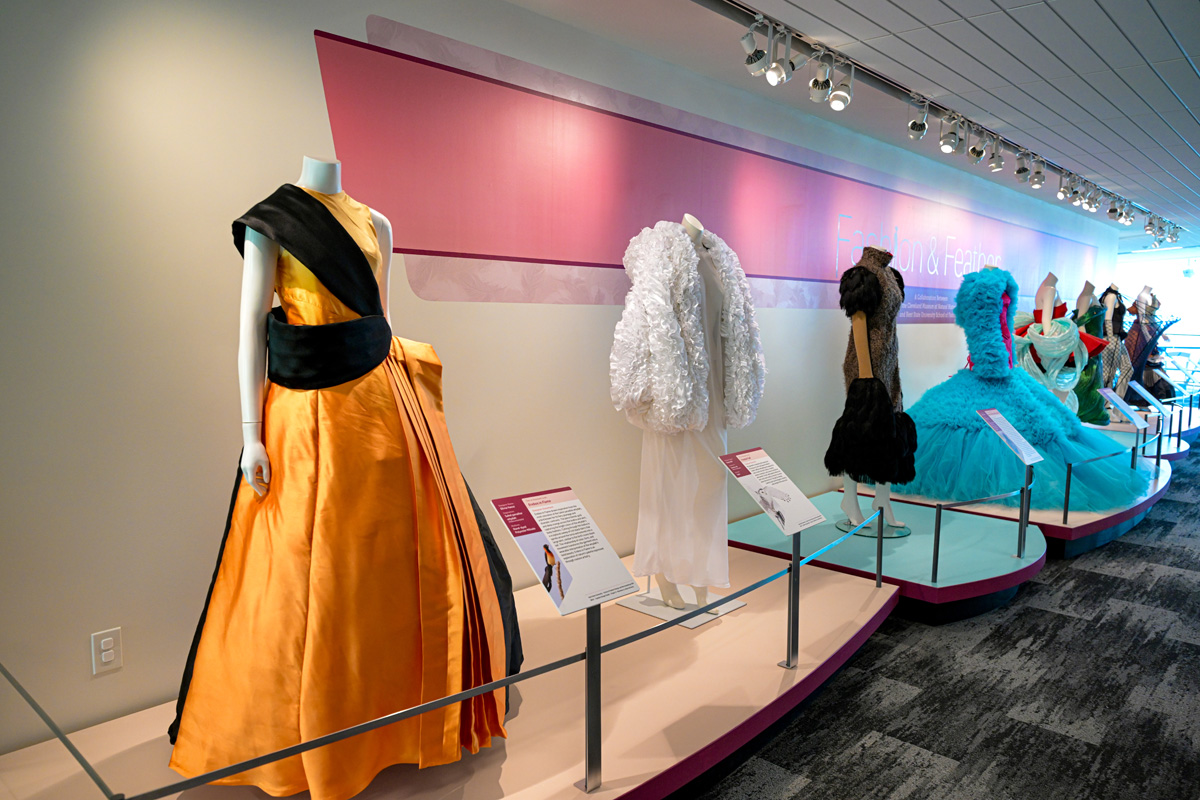
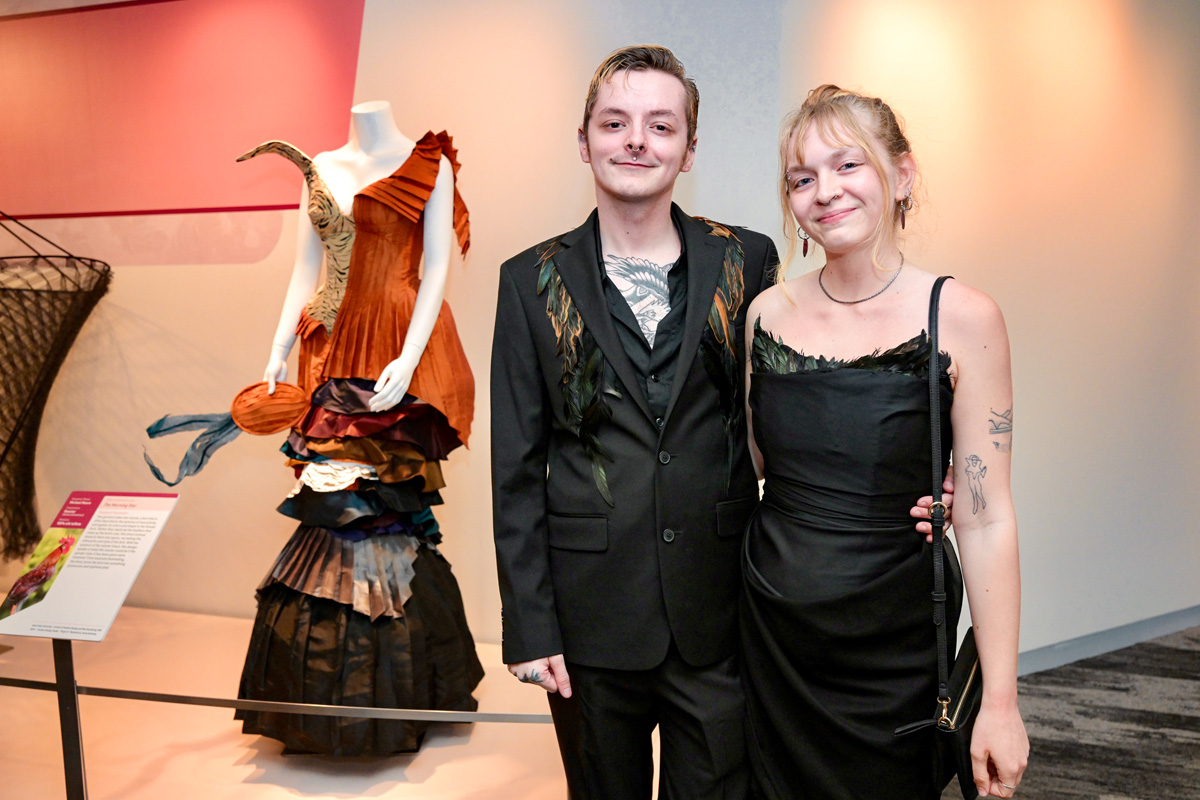
Design a garment inspired by migratory birds without using any actual feathers: This was the challenge presented to Kent State University fashion design students as part of a new partnership with the Cleveland Museum of Natural History, celebrating the connection between nature and fashion design.
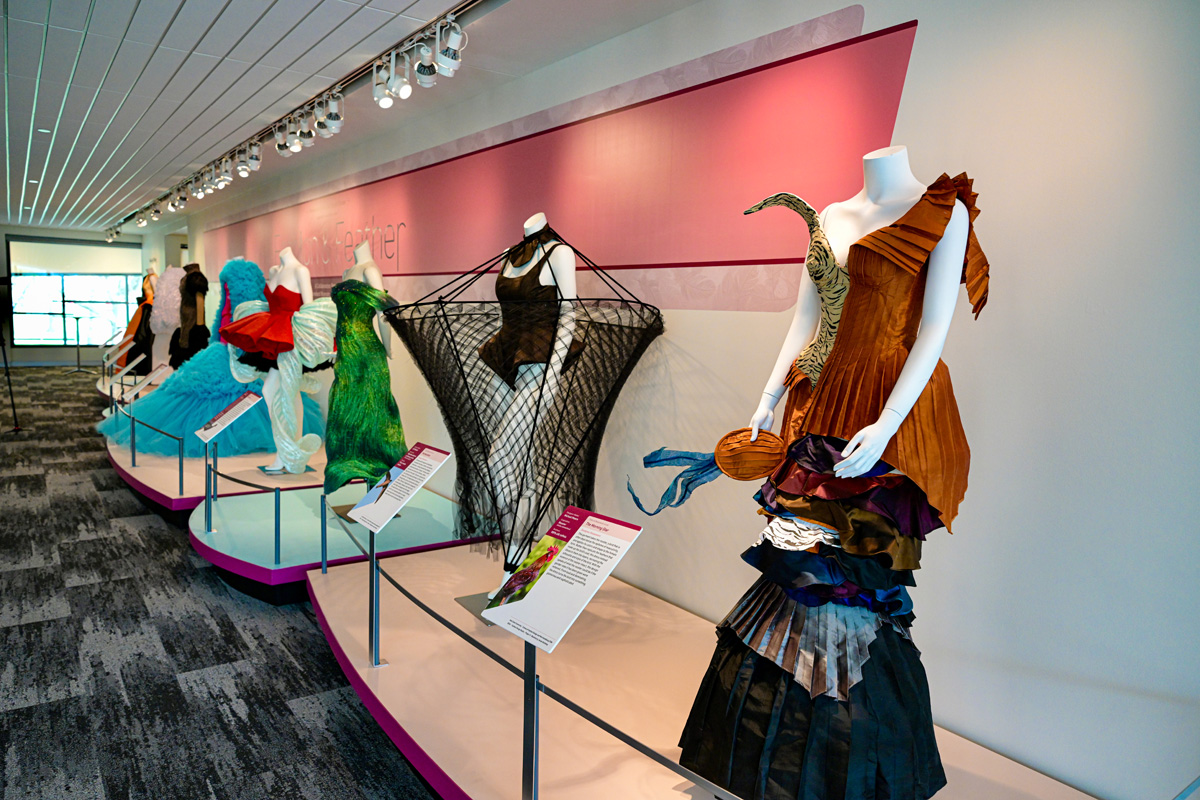
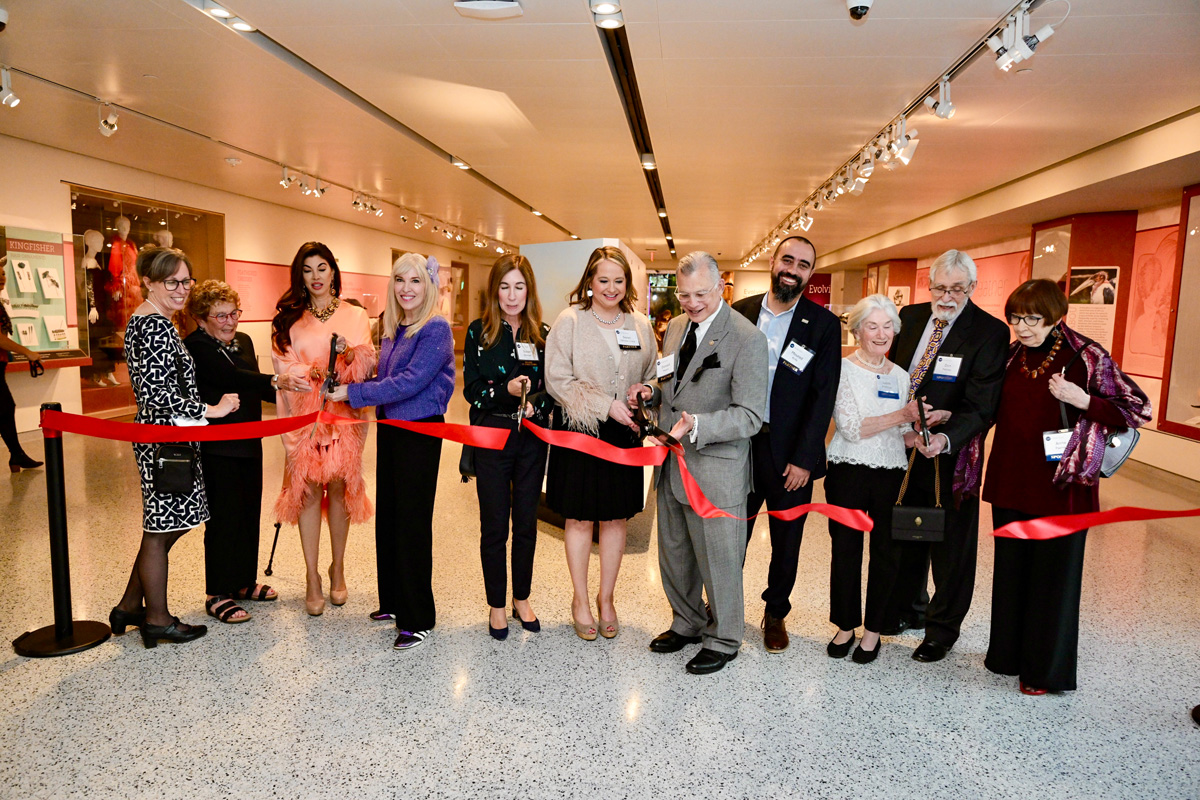
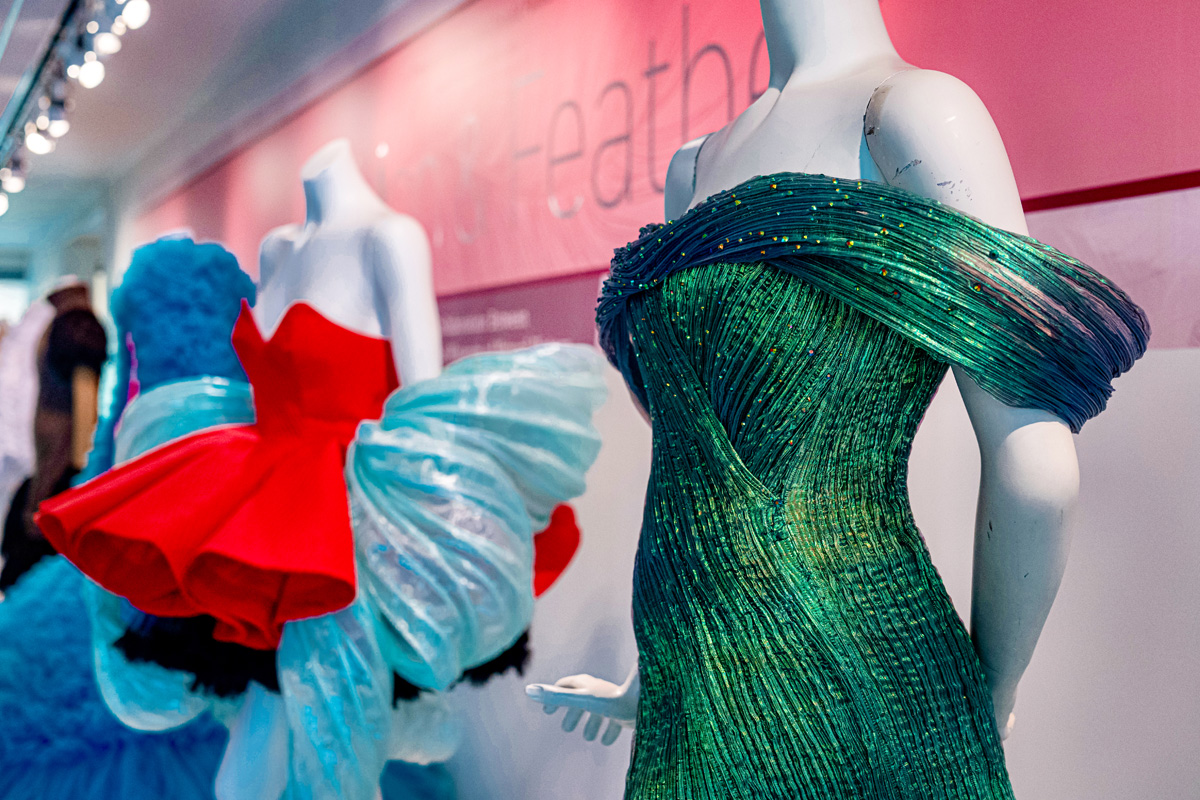
The exhibition, “Fashion & Feather,” debuted on Earth Day, April 22, at the natural history museum and will remain open through Oct. 11, bringing together historic fashion, ornithological specimens, cultural objects and contemporary student designs.
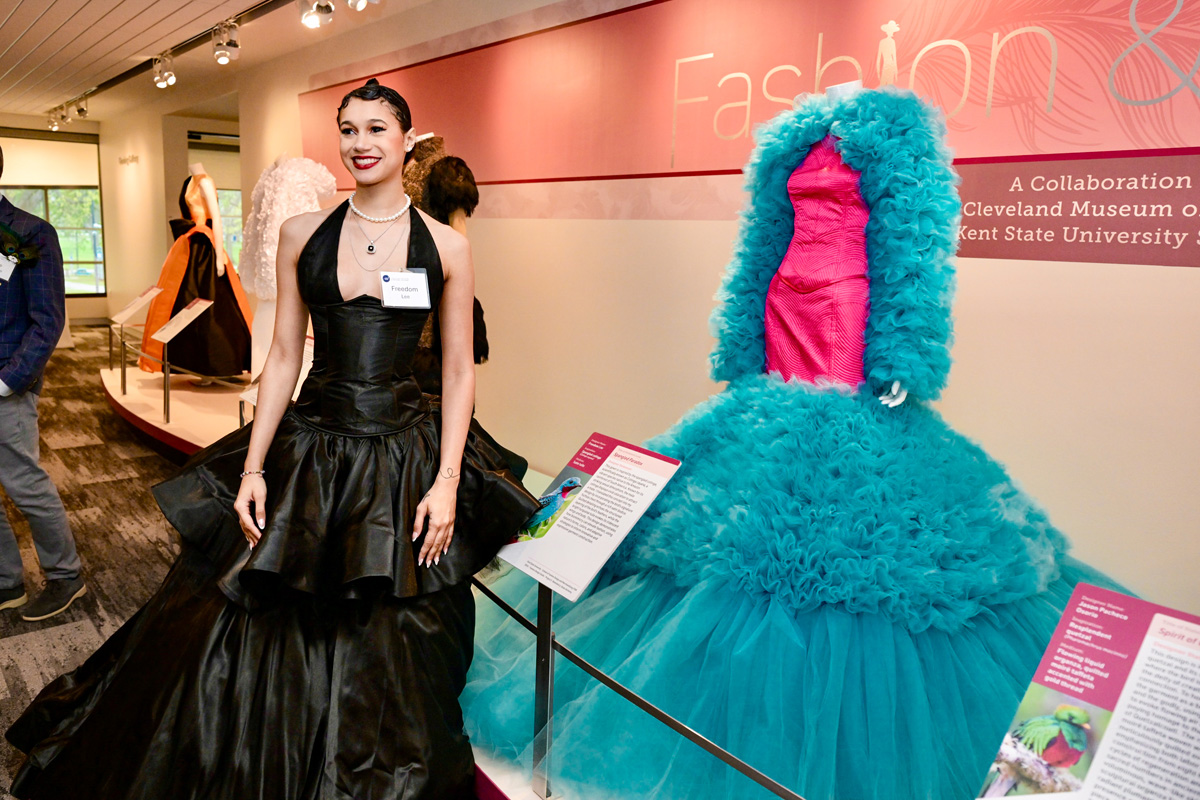
The exhibit brings together the natural history museum, the Kent State University Museum and Kent State’s School of Fashion in a community engagement collaboration.
The project traces its roots to a 2018 exhibit, “For the Birds,” presented at the Kent State University Museum and curated by Sara Hume, Ph.D., professor and museum curator, and was born out of a desire for a fresh collaboration between the university and the natural history museum.
“This collaboration really began as the seeds of an idea between the museum and leadership at Kent State University and the Cleveland Museum of Natural History,” said Sarah Spinner, Ph.D., J.D., director of the Kent State University Museum. “The museum is always thinking more broadly about how fashion is inspired by the world around us and looking to expand partnerships across the region. So, we took the initial idea and developed it into an extraordinary collaboration.”
Students at the Center
Always at the heart of all Kent State’s community collaborations, though, is the idea of how they can benefit students. As with past collaborations, this one became a project for fashion design students in the junior design studio, to encourage them to stretch their creative wings and look for deeper connections for their work.
“This project came out of the partnerships we have as a school and a university,” said Mourad Krifa, the Margaret Clark Morgan Director of Kent State’s School of Fashion. “Kent State University is really about connecting to the community and improving life around us.”
Krifa said his priority is always turning every opportunity into a learning experience for fashion students.
“This project is an amazing learning experience because it involves things like biomimicry, things that are very inspirational to fashion from the perspective of not just aesthetics, but also the intersection of technology, the intersection of functionality with aesthetics. And biomimicry is a great example of that,” Krifa said.
‘For the Birds’
Hume’s 2018 exhibit was staged to celebrate the 100th anniversary of the passage of the Migratory Bird Treaty Act of 1918. At the turn of the 20th century, the popularity of birds in fashion led to fears that some species could face extinction. As a result, organizations such as the National Audubon Society were formed to protect the animals, which ultimately led to the passage of protective legislation.
“We thought this would be a great pairing with the Cleveland Museum of Natural History, so it has been reimagined, and the exhibit now focuses on feathers and all of the pieces of the original exhibition that have actual feathers on them,” Hume said.
The new exhibit, she said, will be organized around various species of birds – peacocks, ostriches, pheasants, roosters – as well as different types of feathers.
“There are all sorts of different kinds of feathers on birds, and they have different functions. And when the feathers are used in fashion, when man makes use of feathers, they have yet other functions, and they serve different functions for fashion,” Hume said.
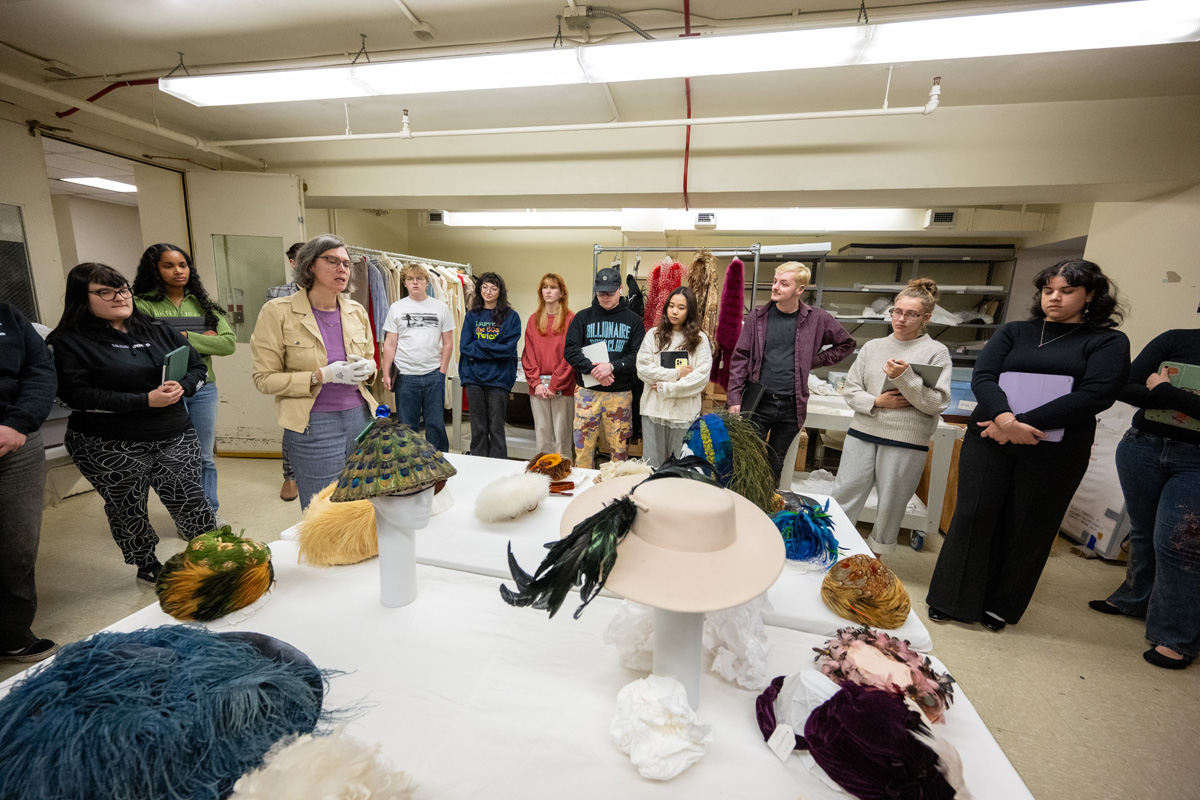
The university museum pieces on display will include hats, dresses, fans and other objects, including a 1905 hat adorned with five pheasants.
“I think that is really one of the best examples of how fashion got away from itself and got carried away with the trend for using birds,” Hume explained.
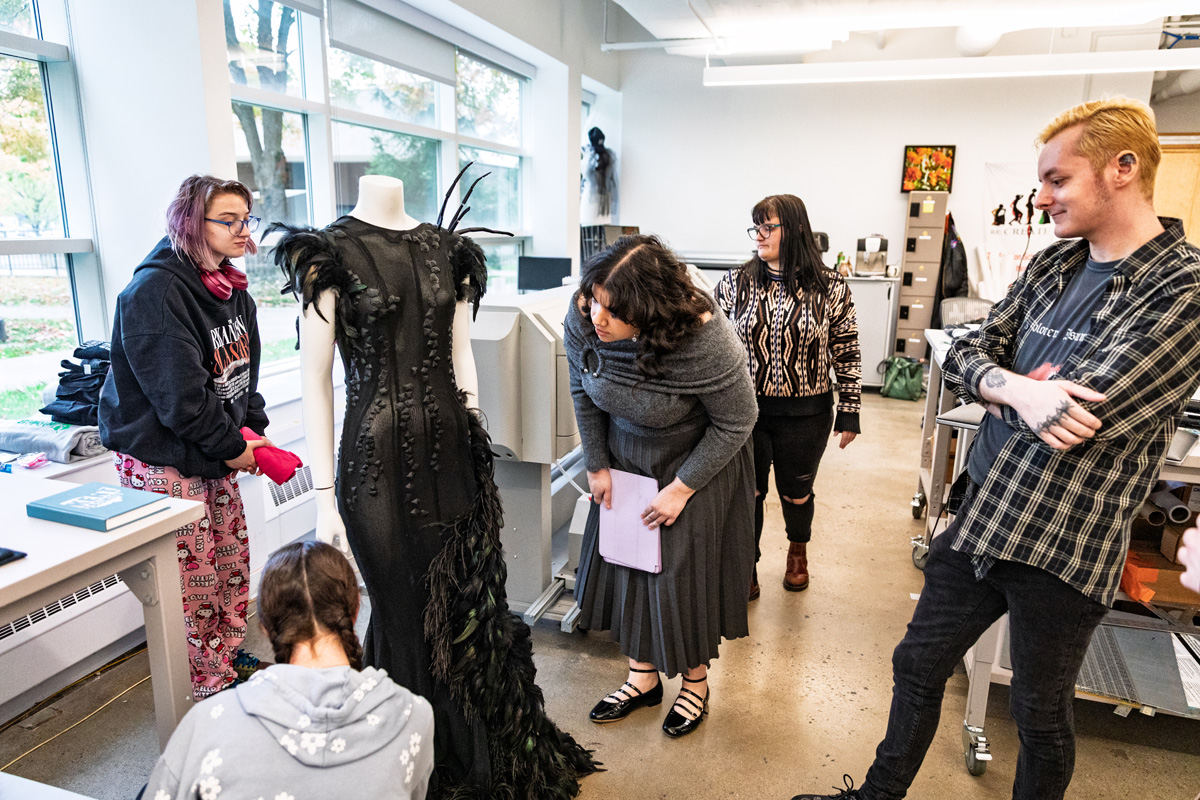
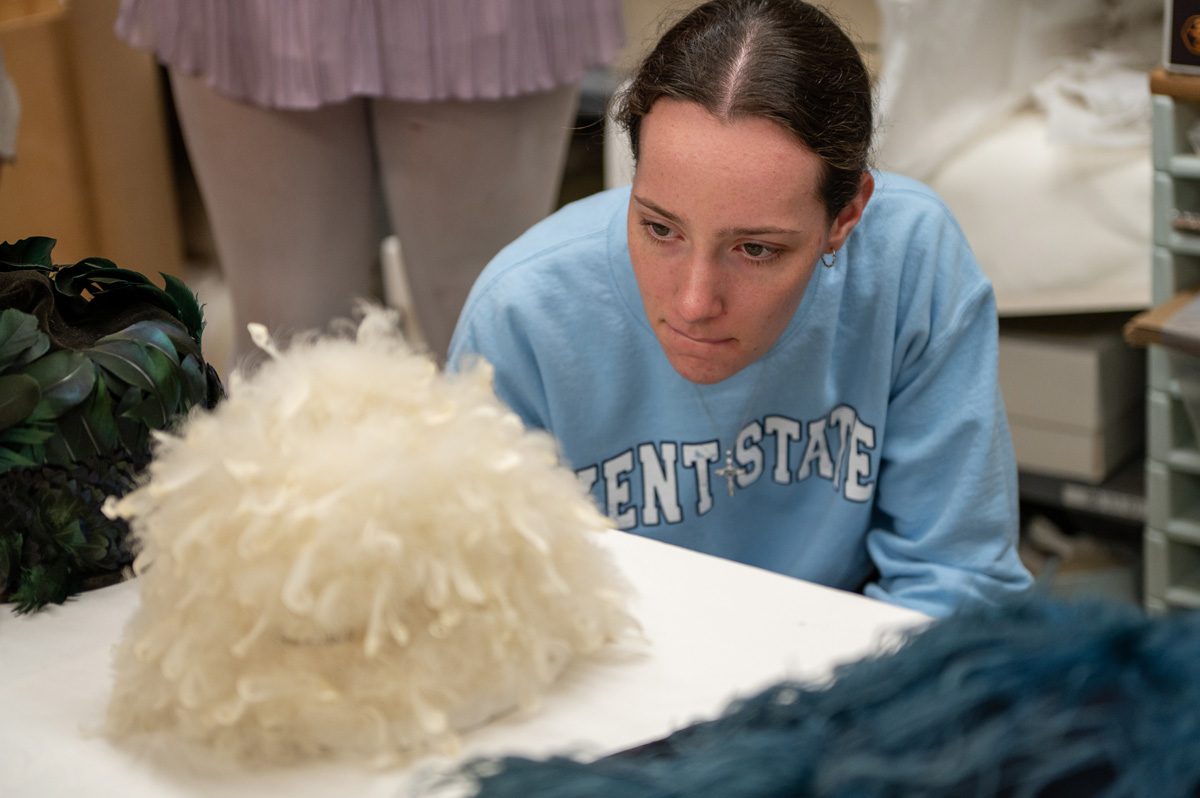
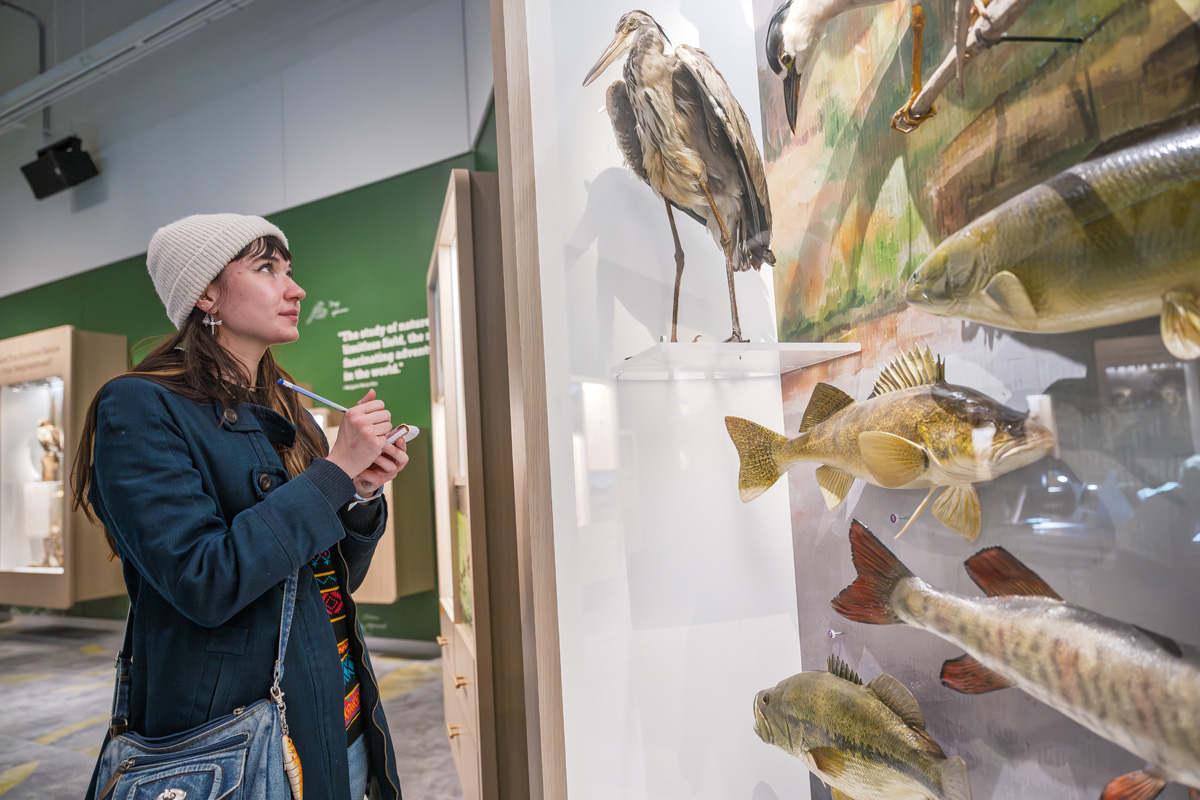
For this design project, Hume gave the students a tour of the university museum’s collection of feathered fashion, and the students spent time at the natural history museum before selecting a bird to mimic in their design.
Mimicking Nature
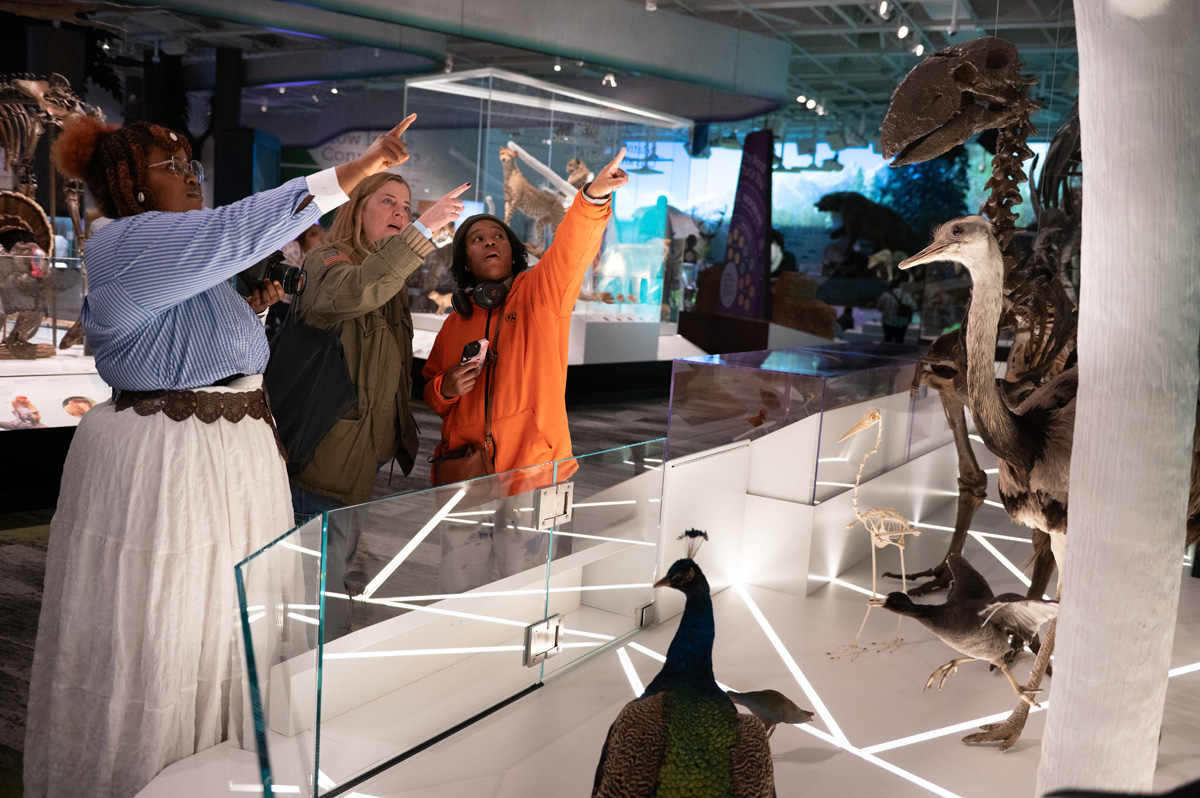
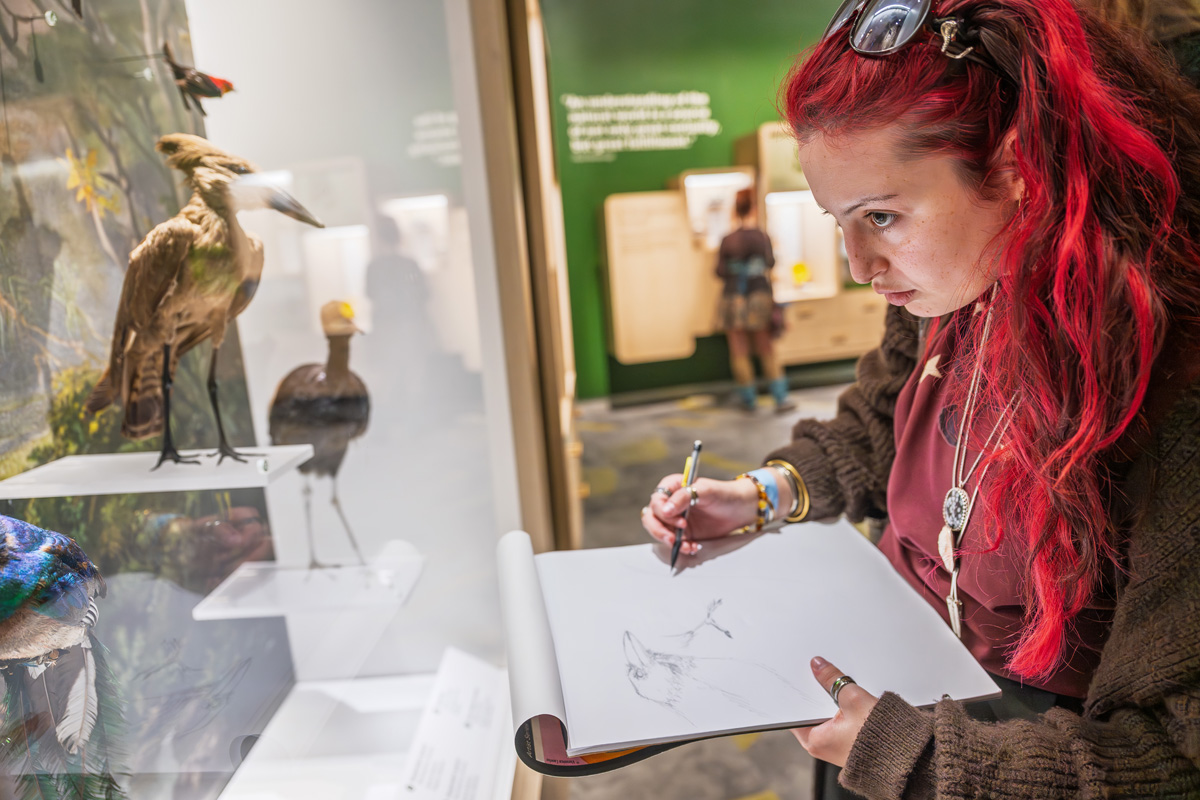
“Our students visited the Cleveland Museum of Natural History and found so much inspiration,” said Daniel Fladung, assistant professor of fashion who leads design studio courses for upper-level undergraduate students, along with Lecturer Jackie Hughes, Senior Lecturer Archana Mehta and Professor Linda Ohrn-McDaniel.
“They were interacting with all the different exhibits, taking photos, and drawing directly from those pieces. It was just really inspiring to watch them be so excited and engaged in this project,” Fladung said.
The theme of biomimicry was to challenge students to truly use nature as inspiration.
“We landed on biomimicry – not actually taking parts of the birds and utilizing them – but rather mimicking those parts of the birds and creating fashion with concepts and ideas,” Fladung said. “It’s not just about the aesthetics of the bird, it’s about thinking more deeply about it, such as their feather patterns, or their bone structures, or aerodynamics.”
Extensive research before designing is something the school emphasizes for its students.
“Proof of concept is more important than it’s ever been,” he said. “Emerging designers are all trying to get placement in the industry, and they are being asked those questions: Where did your ideas come from? How did you come up with this? They are being asked for that primary research.”
Students then used the fashion school’s textile lab for laser cutting, embroidery, 3D printing and digital printing on fabric to create “feathers” or the concept of them.
Students Spread Their Wings
In December 2025, a team from the fashion school and the natural history museum spent several days reviewing the garments and selected 10 to be used in the exhibition.
Meghan Strong, Ph.D., director of collections at the Cleveland Museum of Natural History, took part in the selection process and said she was amazed by their work. “The creativity, the amount of detail – they brought it – they’ve really done their homework.”
Abbigail Blackford, a junior fashion design major from Marion, Iowa, selected the ruffed grouse as her inspiration bird, as she was taken by the plumage around its neck.
“It reminded me of the Renaissance period and the Elizabethan period, where they had these huge standing collars and [Queen Elizabeth] wore these outfits almost as her defense,” she said.
The bird inspired her to experiment with ruffled collars and lots of volume.
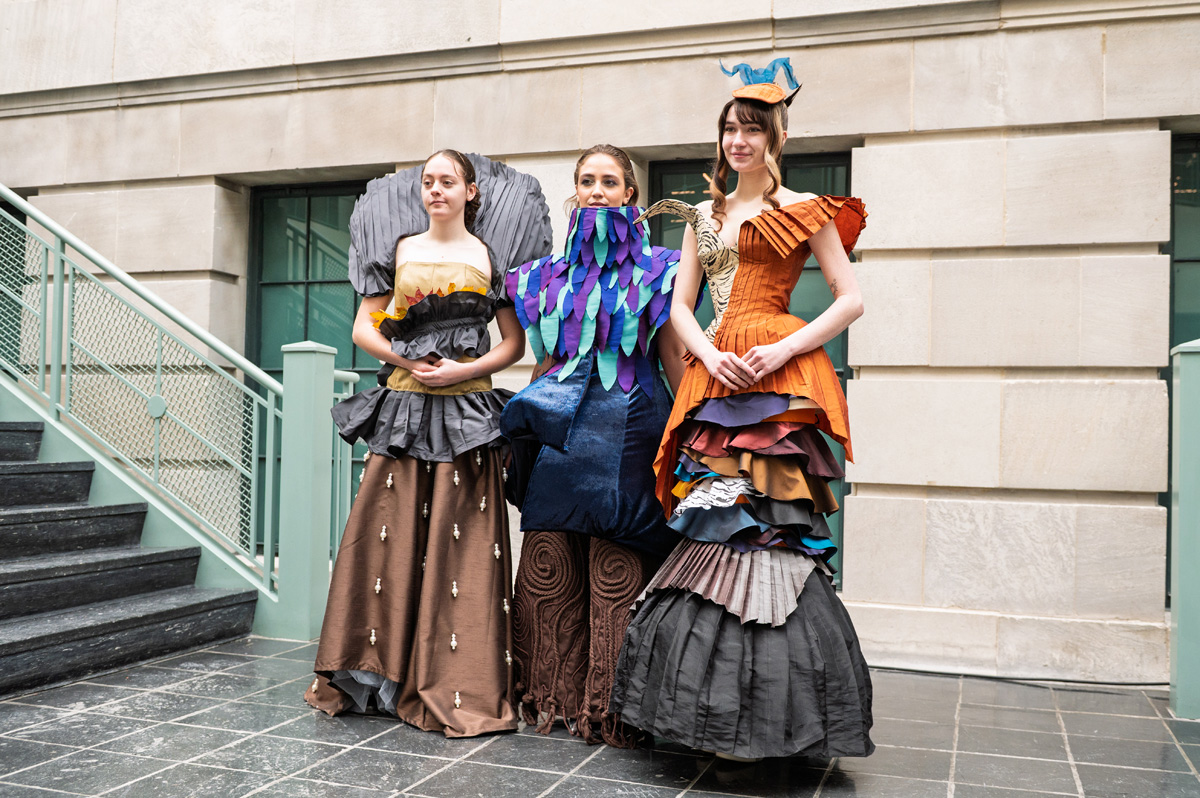
For her garment, Blackford designed a long strapless dress of dupioni silk, with a large hand-pleated shoulder shrug to mimic the grouse’s ruffed collar. The bodice was constructed of sections of tan and black, while the brown skirt was dotted with pearl beading to add texture and to mimic the white spots on the grouse’s feathers.
“The beads represent the feathers that are all across the bird, and as a way to add a little bit more texture and to add another design element to it,” she said.
Blackford selected colors reminiscent of nature and adorned the bodice with actual tree leaves that she preserved in glycerin, to suggest how the grouse would nest in its woodland habitat.
Blackford said the project is just one of the many opportunities she has found at Kent State’s fashion school.
“It has been amazing coming here. The program, the people, the teachers are very knowledgeable, and I’ve been able to learn a lot,” she said. “I wouldn’t have gotten these opportunities if I had stayed in Iowa. I know a lot of people don’t have these opportunities.”
Strutting His Stuff
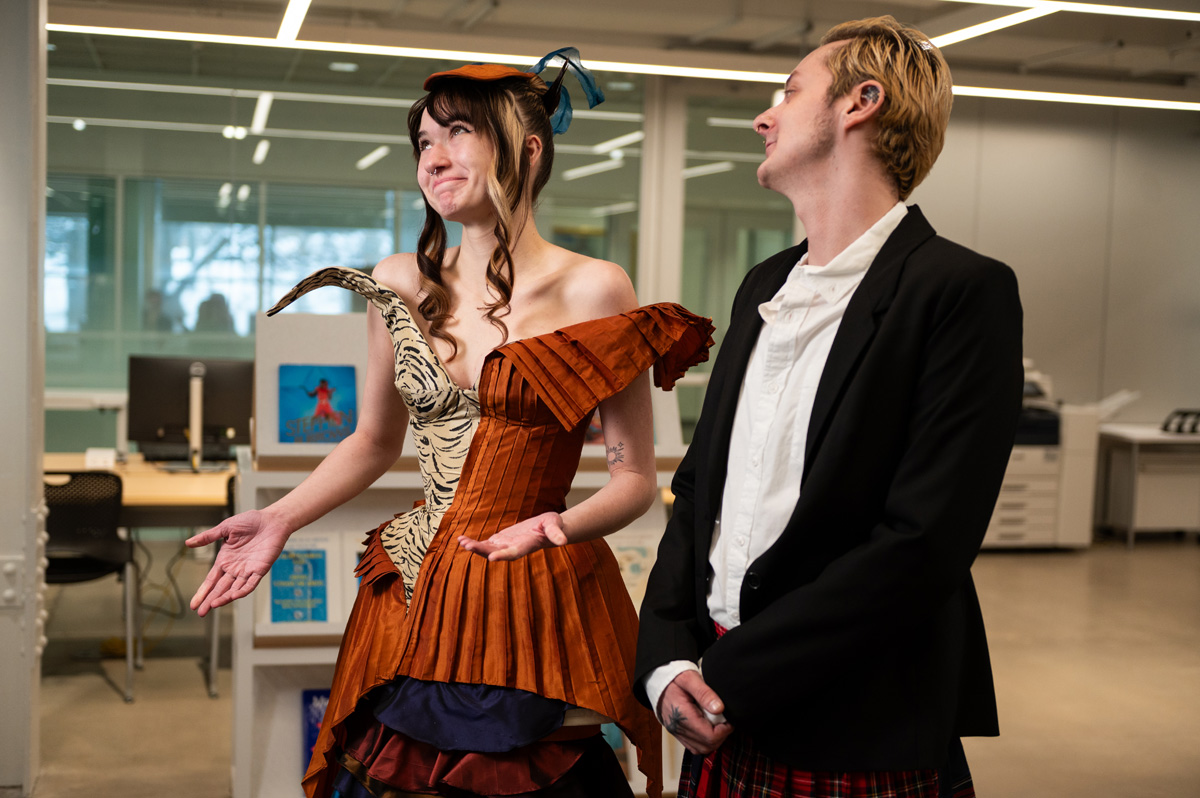
Michael Moore, a junior fashion design major from Akron, Ohio, selected the rooster as inspiration for the dress he designed.
“There are plenty of birds out there that are more elegant and beautiful, but I wanted to showcase something that might seem mundane or that we’re used to and turn it into something extravagant and beautiful,” he said.
The challenge of creating “feathers” without actually using any feathers was a creative leap that Moore was happy to take.
“We have a lot of resources here on campus that can help us execute that, whether it’s making feathers out of fabric, maybe it’s mimicking feathers. Maybe you would embroider feathers or use laser cutting,” Moore said. “There’s actually a ton of different ways you can do it.”
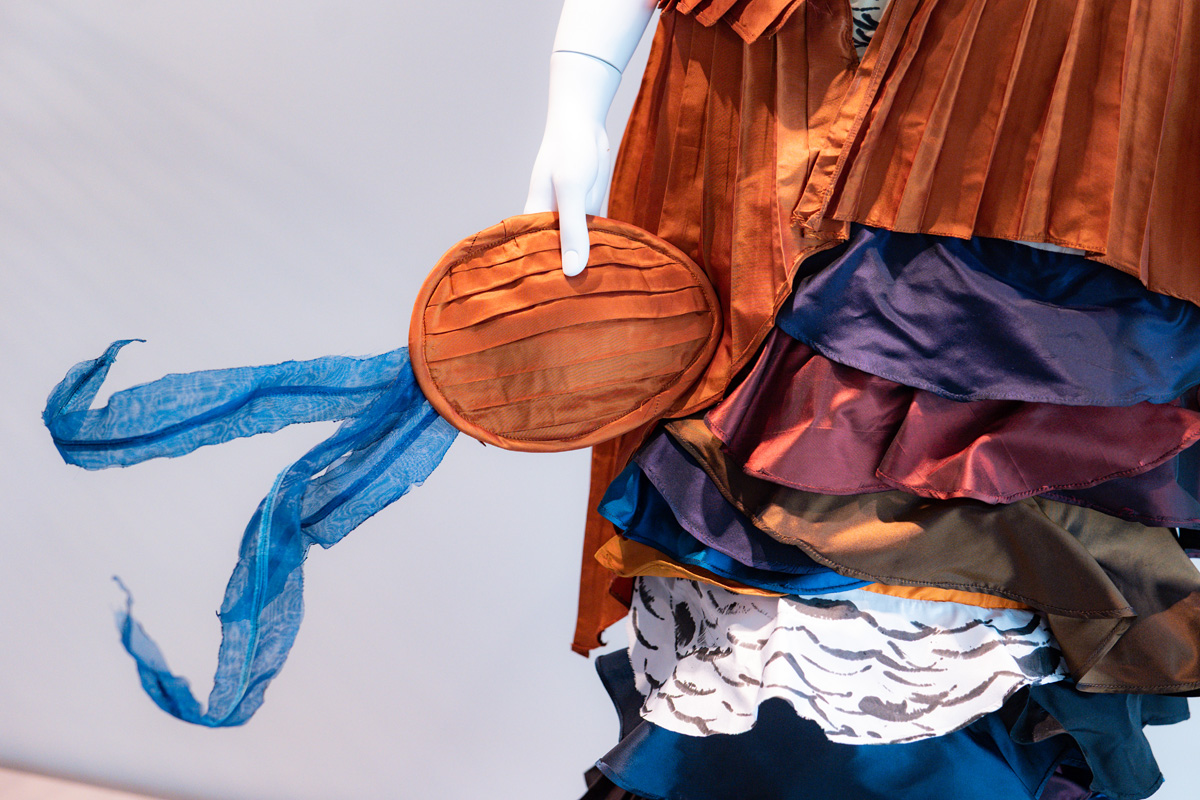
Moore’s finished garment, a multi-layered floor-length dress of varied fabrics, was intended to mimic the multiple colors found on a rooster, while a cap sleeve and fascinator hat were crafted of fabric designed to look like feathers. He hand-pleated the layers and painted the prints on pure silk fabric.
“Roosters typically signify masculinity across all cultures,” he said, “so I wanted to pose the question: ‘What could the rooster be if we could remove that role?’ And I wanted to apply the odd shape of the bird and the texture of the layered feathers to a woman’s evening gown.”
He hopes to one day break into the couture market and plans to study abroad in London for the summer and pursue an internship with British designer Vivienne Westwood.
Finding Inspiration in the Mundane
Ana Clara Jardim De Souza E Silva, a junior fashion design major from Curitiba, Brazil, is part of the American Academy, a dual-enrollment program offered jointly by Kent State and the Pontifical Catholic University of Paraná (PUCPR), located in Curitiba, Paraná, Brazil.
Silva has always had a love of fashion and said she was interested in studying abroad. When she discovered Kent State’s renowned fashion school, she knew the American Academy was the right path for her education. She completed her first two years at PUCPR before coming to the Kent Campus and said her love for fashion design has only grown since arriving at Kent State.
For her feathers project, Silva selected the wood duck as inspiration for her avant-garde garment. “I just love volume and playing with different silhouettes and just doing something really out of the box that has never been seen before,” she said.
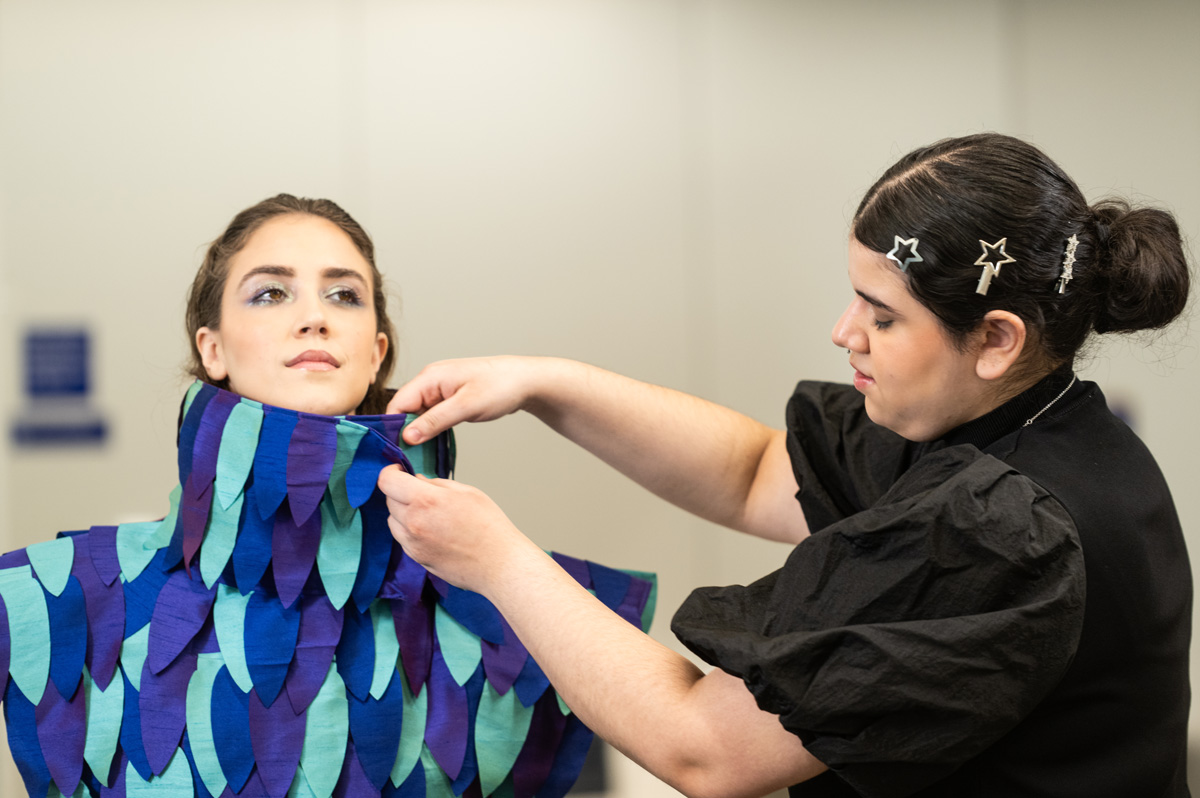
Her final garment was a sculptural two-piece outfit, with a high-neck jacket crafted of slices of material layered to mimic feathers in shades of blue and purple to suggest the colors of the duck’s iridescent feathers. The top extends to a voluminous bottom of blue velvet; its sheen meant to represent the wet look of the duck, with brown pants adorned with cording used to resemble the knots of a tree trunk.
“Wood ducks nest on trees, so I made wood pants,” Silva said. “I feel like nature is all around us, so as designers we have to just look at the smallest thing and find inspiration in the mundane things. We have to keep pushing ourselves, keep designing and keep going forward.”
Silva is spending the spring semester at Kent State’s New York City Fashion and is hoping the experience in a global fashion capital will help her build her professional network and create connections. “I love seeing my creations come to life,” Silva said. “This is where I’m supposed to be. This is what I want to do for the rest of my life.”
All the student designs will be featured in a runway show at the Cleveland Museum of Natural History to mark the closing of the exhibition in October.
Meeting the Challenge
Krifa said the looks were impressive.
“I’m so proud of the work that we’ve seen, and our faculty did a great job nurturing our students’ creativity for this project,” he said.
Every semester, faculty give students routine design projects – create a dress or a suit – but a challenge of this nature is different, Krifa explained.
“When they’re met with a challenge and given a prompt that goes beyond just making a dress or a look and provides them with inspiration – like in this case, the migratory birds from the natural history museum – that challenges them even more and that makes them think outside the box and typically the outcomes we see as a result are at a much higher level.”
“That’s one of the learning outcomes we are trying to enforce in our students, it’s not just about making a look and making a product, it’s also about being leaders and thinking ‘What’s next?’ and thinking about the next innovation,” Krifa said. “Innovating fashion from creative minds always has to be inspired by things that are external to the traditional ways of thinking.”
Successful Collaboration on Display
Strong said merging the Kent State University Museum collection with the natural history museum’s collection and the student-designed garments has been a successful venture.
“They have dresses that incorporate ostrich feathers that they want to display. Well, we have real ostriches, taxidermy birds, that we will be able to display alongside their pieces so that we can show this is what these objects actually look like in nature – this is where these birds come from,” Strong explained.
Items from the museum’s cultural anthropology collection will be used to spark discussion about how feathers are part of fashion in many parts of the world, not just Western society, she said.
“We have a number of ostrich fans and a headdress that we will be showing that came from Africa,” Strong said, explaining how for at least one tribal community in Africa, successfully hunting an ostrich becomes part of that family’s status. “They’re able to utilize those bird feathers as part of their own regalia, which they would wear for the rest of their life. It’s very interwoven into ceremonial and religious aspects for them, as opposed to something that we might just wear for an important occasion.”
The exhibit featuring the pieces from the university museum will be displayed in the newly reimagined Visitor Hall on the lower level of the natural history museum, while the student-created garments will be featured in a separate second-floor exhibition that will include Kent State photos and video, detailing how the garments were created.
Spinner said she was pleased the museum pieces were being featured in the Visitor Hall, because admission there is free to all, and she appreciates the opportunity to display the collection where it can be accessible to many.
“Accessibility – to the arts and to museums – has been one of my primary values throughout my career,” she said. “So the opportunity to showcase an extraordinary interdisciplinary collaboration that would be open to the thousands of visitors who pass through the Visitor Hall was especially exciting for us.”
“Fashion & Feather” runs through Oct. 11 at the Cleveland Museum of Natural History.