
Ask most adults what a "digital native" is and they'll tell you: a kid who grew up with technology and therefore knows how to use it. Rick Ferdig, Ph.D., would like to respectfully push back on that.
"They might know how to use AI to do TikTok or whatever," said Ferdig, Summit Professor of Learning Technologies in Kent State University's College of Aeronautics and Engineering, told Kent State Today. "But to actually understand how to use it for their learning, or how to use it ethically, or how to use it to get a job or be successful in their job – those are things they're not quite ready for."
Growing up with smartphones, Ferdig argues, doesn't make a student ready for a workforce being reshaped by artificial intelligence. What it takes is actual instruction, which requires teachers who are actually prepared to provide it. And right now, in Ohio, that’s not happening nearly enough. Or young enough, Ferdig said.
That's the gap Kent State's Teach CS program is built to close. With approximately $857,000 in new funding, this is the latest installment in a series of grants from the Ohio Department of Education totaling more than $2.3 million since 2024. With this funding, Kent State is training and endorsing K-12 teachers in computer science instruction across every grade level and subject area. The teachers signing up for these courses are not who you might picture. And what they leave with has started to surprise even their instructors.
When a music teacher enrolled in the program, his instructor, Emily Baumgartner, Ph.D., assistant professor of Emerging Media and Technology, wasn't sure what to expect. But by the end of the course, he had designed something so unexpected it surprised her.
"That's incredible," she recalled thinking. "Wow."
He wasn't alone in surprising her. Since Kent State began participating in Ohio's Teach CS program, Baumgartner has watched kindergarten teachers, Spanish teachers, English teachers and self-described “non-tech” people work their way through coding concepts and emerge with something they didn't expect to have: confidence, and a plan for their own classrooms.
A Gap in Ohio's Classrooms
Ohio has computer science standards that span kindergarten through 12th grade. But having standards and having teachers qualified to meet them are two different things. Across the state, very few schools offer what are known as EMIS-coded computer science classes – courses officially designated as computer science instruction in the state's Education Management Information System. The reason, Ferdig says, is straightforward: you can't offer the classes if you don't have anyone qualified to teach them.
The question is, is it because we don't have the teachers and so we can't have the classes?" he said. "Or, do we not have the classes because we don't have the teachers?
It's a chicken-or-the-egg problem that the state has decided to crack from the teacher side. The Teach CS initiative, championed in part by Mike Duffey, chancellor of the Ohio Department of Higher Education, began funding universities across Ohio in 2024 to train and endorse teachers in computer science instruction. Kent State is one of approximately 17 educational institutions participating statewide.
The new round of funding will support approximately 25 teachers pursuing a Master of Education with computer science endorsement preparation, a computer science endorsement for around 20 teachers, and roughly 50 teachers completing a new professional development course focused on artificial intelligence.
And the window for reaching students is narrowing, according to Ferdig. He shared that research suggests that if students aren't introduced to computational thinking before high school – or even middle school – the opportunity to spark real, lasting interest may pass.
Not Your Typical Computer Science Class
Computer science, Ferdig is quick to point out, is not just coding. It encompasses hardware, software, networking, artificial intelligence, robotics, data analysis, algorithmic thinking and what he calls the "impact of computing" – the societal and ethical dimensions of how technology shapes the world. Ohio's own K-12 CS standards are organized around six domains: computing systems, networks and the internet, data analysis, algorithmic thinking and programming, artificial intelligence and impact of computing.
That breadth is partly what makes the program accessible to teachers who don't think of themselves as "tech people." When Ferdig talks to hesitant teachers, he sends them the computer science standards first.
"My guess is, because this is what it was back when I was in college, you were sitting in front of a computer coding," he said. "But if you go back and look at those standards, you see a lot of really important things that touch on a lot of different content areas."
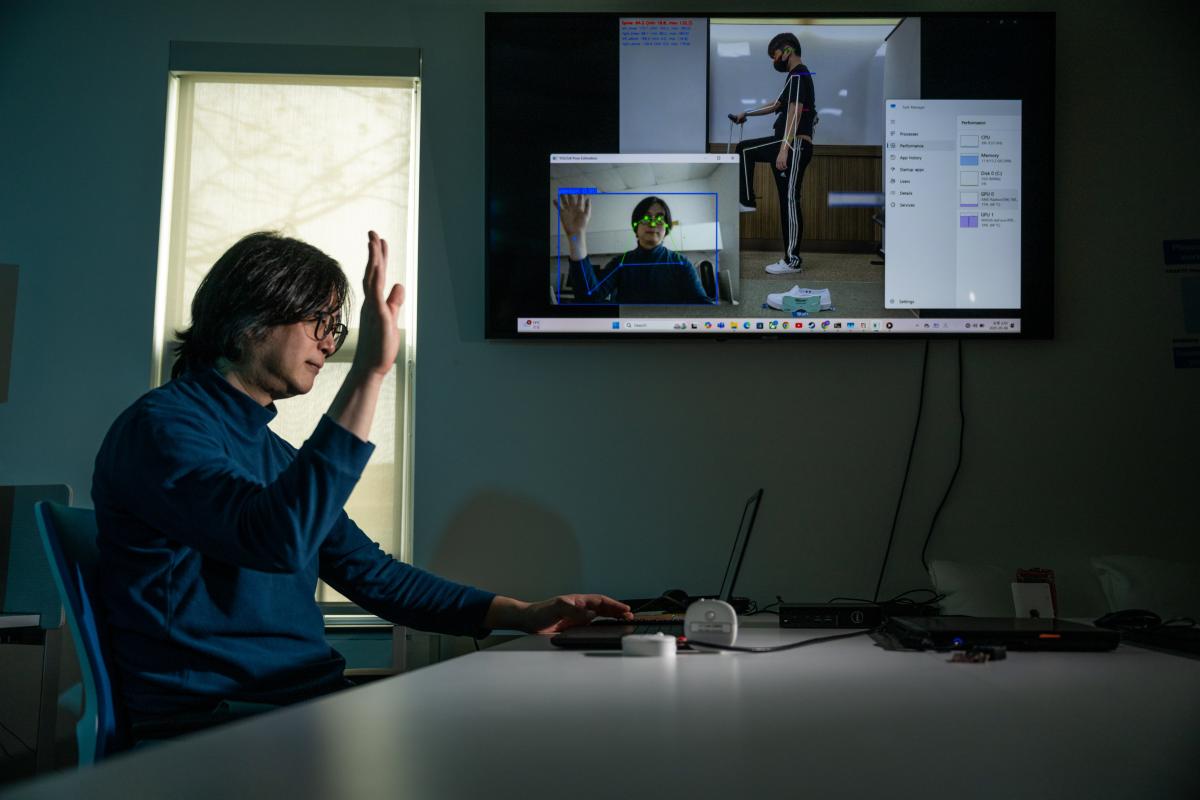
At the course level, that philosophy is embodied in Baumgartner's Creative Coding Fundamentals class – the first course most participants take in the Teach CS program. The class teaches programming not through abstract math problems, but through visual art. Students write code and immediately see it rendered on screen as color, shape and movement.
"It's not like your typical class where you're staring at a blank screen and making math happen behind the scenes," Baumgartner said. "It's more like an artistic way of learning programming through pictures, through art. You get instant feedback."
For younger learners – and for the elementary school teachers who will eventually teach them – tools like Scratch and Scratch Jr., developed by the MIT Media Lab, offer an even gentler on-ramp. Drag-and-drop interfaces let children direct colorful characters across a screen, absorbing the logic of giving instructions to a computer without necessarily recognizing it as programming.
"They're understanding that they are giving instructions to do something," Baumgartner said. "And that's the whole point of an algorithm – it’s like a recipe that they're following."
Teachers Teaching Teachers
One of the program's more unique features is its mix of participants. Baumgartner described the most recent cohort as nearly evenly divided among early education, middle school and high school teachers, with subject areas ranging far beyond anything CS-adjacent. Spanish teachers. English teachers. A music teacher. Technology coordinators. One early cohort even included a preschool teacher.
Baumgartner adapted her course specifically with this audience in mind. After the first cohort, she redesigned the final project so that instead of simply demonstrating what they'd learned, participants had to create something they could actually take back to their own classrooms.
I always feel like in an education class it's so important to do things that they could use," she said. "Instead of just, ‘OK, yeah, I'm getting a master's degree,’ but actually having things in the curriculum that they can use in their own classrooms and feel confident teaching.
A kindergarten teacher, for instance, wouldn't be expected to teach her students JavaScript. But she might design a unit using Scratch Jr.
Baumgartner opened the project parameters broadly enough to accommodate every grade level and subject area, asking only that participants articulate their unit's learning outcomes and envision what a student's final project might look like.
The results have occasionally astonished her. One participant built what amounted to a near-complete game as a final project. Another emailed her after the semester ended to report that she'd taught P5 (a type of JavaScript programming) to her own students, and they loved it.
"Stuff like that – I'm like, yay," Baumgartner said. "They're doing it."
Not everyone arrives eager. Some participants come in openly skeptical of their own abilities, and Baumgartner takes that seriously.
"I think it's the imposter syndrome sometimes," she said. "Oh gosh, this is new, I'm not comfortable. And it's hard when you're not comfortable with something to have a whole program on it."
Her response is proactive: reaching out to struggling students before they've asked for help, offering to meet and talk through projects, framing feedback in explicitly encouraging terms. “No one has failed my class yet,” she said with a laugh.
"Once you get it," she said, "it's like, OK, this isn't as bad as I thought."
CS Is for Every Classroom
Since receiving its first round of Teach CS funding in 2024, Kent State has helped nearly 100 Northeast Ohio teachers complete the program. Another 28 are currently enrolled, and approximately 45 more will begin this spring as part of the new funding round.
Computer science is often perceived as a subject for well-resourced schools – places with one-to-one device programs, dedicated CS labs and students already primed for tech careers. Baumgartner disagrees.
"I think some people think of this subject area as for people who have money, for people who have all this technology," she said. "And it's not really the case – because you can teach this without a computer."
The software her students use runs in a browser and is compatible with Chromebooks and most smartphones. More fundamentally, the concepts underlying computer science – algorithmic thinking, logical sequencing, breaking a problem into steps – can be taught with nothing more than a room full of kids and a prompt.
"I actually did a workshop where I had kids just moving around in a loop," she said, as a way to physically demonstrate how a computer loop functions. "They were just moving around the room in circles. You don't even need a computer for that."
The message, she said, is simple: "It's not for certain people. It's for everybody."
The Ripple Effect
The larger vision Ferdig describes is one of cascading impact. Each teacher who earns a CS endorsement through this program returns to a classroom, a school, a district and brings that knowledge with them. Over a career, a single teacher might reach hundreds of students. In communities where no CS classes currently exist, an endorsed teacher might be the reason one appears on the schedule.
"Most of our applicants have said: I'm teaching X right now, whatever X is," Ferdig said. "And I really want to teach CS, but our school doesn't have CS, and our school won't have CS because no one is qualified to teach it. But if I'm endorsed, they'll offer it."
That's the rolling momentum the state is counting on: more endorsed teachers leading to more classes, more classes leading to students who arrive at college – or the workforce – with a foundation that didn't exist a generation ago.
Ferdig is direct about what's at stake. Artificial intelligence is reshaping careers faster than education has historically been able to adapt, and he doesn't think the field has the luxury of a slow response.
AI is not going to replace teachers," he said. "But AI is going to replace teachers who don't know how to use AI.
For Baumgartner, the stakes feel closer to home than any statistic. She thinks about the teachers who arrive in her class nervous, certain they're in over their heads – and she thinks about the students waiting in their classrooms.
"This could be for any type of teacher," she said. "It can work in any classroom. We've had music teachers, kindergarten teachers, preschool teachers, Spanish teachers – all sorts of teachers of different subjects who are all able to implement this in some way."