Every year, drug-resistant bacteria kill hundreds of thousands of people worldwide. In the United States alone, methicillin-resistant Staphylococcus aureus — better known as MRSA — sends hundreds of thousands of patients to the hospital and claims tens of thousands of lives. Conventional antibiotics, once the reliable frontline of defense, are losing ground. Bacteria evolve. Drugs fail. The gap between what medicine can offer and what patients need keeps widening.
Inside two Kent State University laboratories, a biologist and a chemist have spent years trying to close that gap.
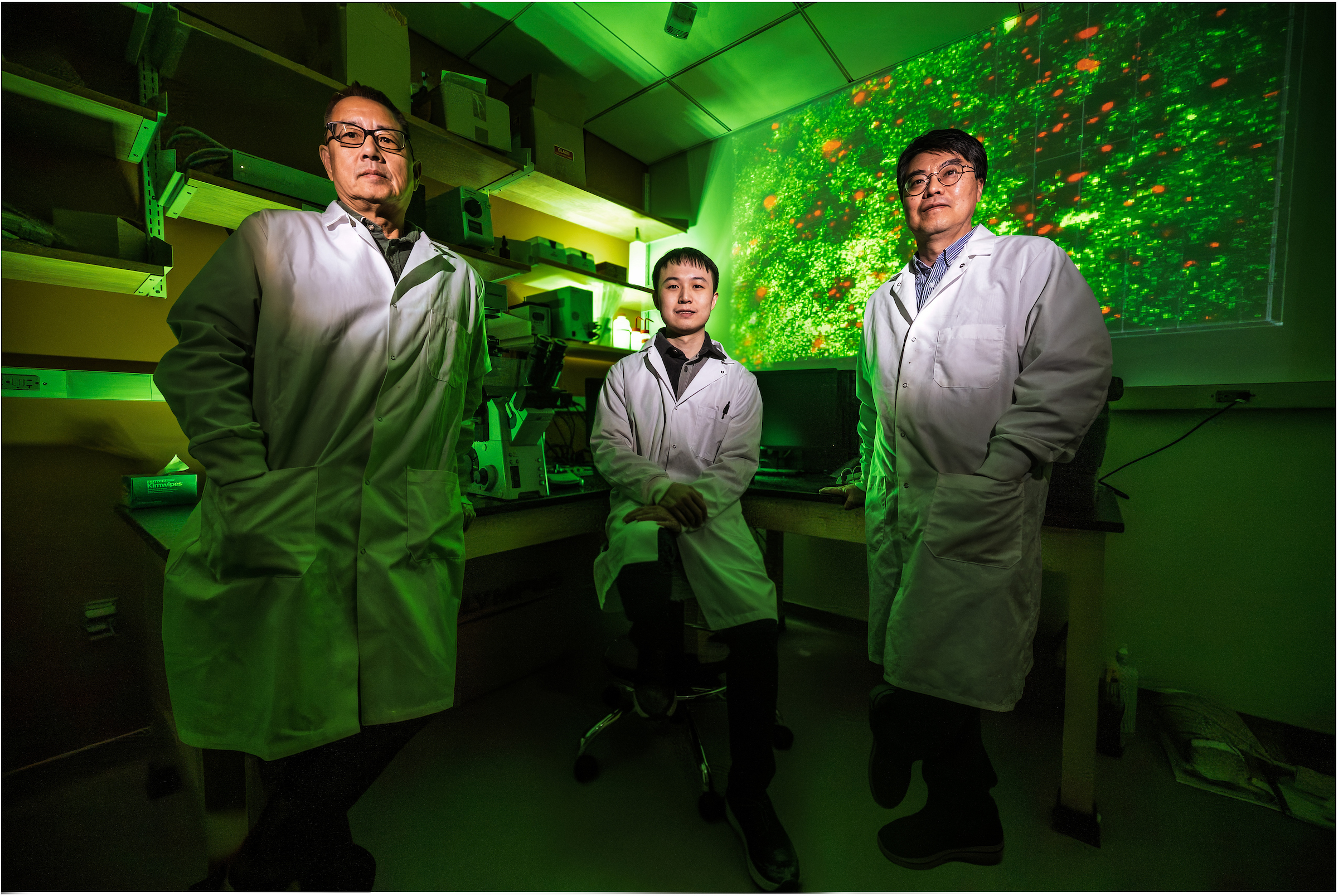
Dr. Min-Ho Kim, a professor in the Department of Biological Sciences, and Dr. Songping Huang, a professor in the Department of Chemistry and Biochemistry, have built one of the more unusual research partnerships on campus — one that crosses departmental lines, combines distinct scientific disciplines, and has now produced a patented antimicrobial compound with the potential to treat infections that have outsmarted modern medicine.
Their work recently resulted in a U.S. patent for a compound derived from Lawsone, a naturally occurring substance found in henna plants. The compound works by targeting an enzyme called NDH-2, which plays a critical role in the metabolism of certain bacteria — including MRSA — but does not exist in human cells. That distinction is important: because the target is unique to the pathogen and not present in the patient, the compound can attack the bacteria without the toxicity risks that complicate many antimicrobial treatments. Perhaps more significantly, because NDH-2 is not targeted by any existing antibiotic, the compound sidesteps the resistance mechanisms that have rendered so many conventional drugs ineffective.
“What excites me about this approach is that we’re not trying to do what existing antibiotics already do,” [PLACEHOLDER — confirm with Dr. Kim] Kim said. “We’re targeting something the bacteria need to survive that current drugs don’t touch. That’s where you find new solutions.”

The compound is currently undergoing preclinical studies as a potential topical treatment for skin and soft-tissue MRSA infections — particularly strains resistant to mupirocin and fusidic acid, two widely used topical antibiotics that are themselves facing growing resistance challenges.
The MRSA work is just one thread in a larger tapestry of research that Kim has built at Kent State since joining the faculty in 2012. His lab’s focus on nanomedicine — using engineered nanoparticles to target disease at the cellular level — has led him into research territory that spans some of the most consequential health challenges of our era. In addition to his antimicrobial work, Kim’s lab is actively investigating a minimally invasive approach to treating Alzheimer’s disease, using magnetic nanoparticles and high-frequency electromagnetic fields to break up the amyloid plaques associated with cognitive decline. His team is also developing nanoparticle-integrated scaffolds designed to accelerate healing in chronic wounds — a problem that disproportionately affects diabetic patients and others whose bodies struggle to repair damaged tissue.
It is, in scope, the kind of research portfolio that reflects what Kent State has become as an institution. In 2023, the university earned Carnegie R1 classification — the highest designation available for doctoral universities, recognizing institutions with the highest levels of research activity. For a university in Northeast Ohio to hold that designation speaks to a sustained, institution-wide commitment to advancing knowledge across disciplines.
“Kent State’s R1 status isn’t just a credential — it’s a signal about the kind of environment our faculty are working in and the kind of support that makes ambitious research possible,” [PLACEHOLDER — consider attribution to a research office spokesperson, a dean, or Dr. Kim speaking to the institutional context].
Huang’s research portfolio is equally broad. From his base in the Department of Chemistry and Biochemistry, he has pursued work in three interconnected areas: the rational design of small-molecule antimicrobial agents, the development of iron-based compounds that harness a cellular process called ferroptosis to target cancer cells, and the creation of nanoparticle-based contrast agents for MRI imaging of the gastrointestinal tract. Each line of research is aimed at unmet clinical needs — gaps in what current medicine can do — and each reflects the same design philosophy: start with a deep understanding of molecular biology and build toward solutions with real therapeutic potential.
The collaboration between Kim and Huang grew organically out of that shared philosophy and a shared recognition that antimicrobial resistance is too complex for any single discipline to solve alone. Kim brings deep expertise in how bacteria interact with human biology — how infections take hold, how the immune system responds, how nanomedicine strategies can be engineered to intervene. Huang brings the chemistry — the ability to design, synthesize, and refine molecular compounds with precision. Together, they close a loop that neither could complete working independently.
“Songping can do things in a chemistry lab that I simply can’t do in mine, and I think the reverse is also true,” [PLACEHOLDER — confirm with Dr. Kim] Kim said. “When you work across disciplines like this, you stop asking ‘is this a biology problem or a chemistry problem’ and you just start asking ‘how do we solve it.’”
[PLACEHOLDER — seek a quote from Dr. Huang on what the collaboration means from the chemistry side, and what the patent represents as a milestone].
That spirit of collaborative problem-solving extends directly into how both researchers approach teaching and mentorship — and it reflects a broader Kent State commitment to ensuring that students don’t just learn about research, they participate in it. The university has made expanding meaningful research experiences for students a priority at every level, from first-year undergraduates exploring laboratory work for the first time to doctoral candidates leading their own investigations under faculty guidance.
In labs like Kim’s and Huang’s, that commitment is lived out daily. Students working in these spaces aren’t running routine exercises. They’re contributing to active research into one of the most pressing public health challenges of our time, developing technical skills, scientific judgment, and professional networks that will serve them across careers in medicine, research, biotechnology, and beyond.
“When a student comes into this lab, they’re not here to watch,” [PLACEHOLDER — confirm with Dr. Kim, and seek specific examples of student contributions or outcomes] Kim said. “They’re here to do science. The questions we’re asking are real questions, and the work they do matters to the answers we find.”
[PLACEHOLDER — if possible, seek a quote from a current graduate or undergraduate student in either lab about their experience].
Ronghui Song, who earned his Ph.D. in chemistry at Kent State and contributed to the research behind the patent, is one example of the kind of trajectory this work can produce. [PLACEHOLDER — confirm Song’s current role and position and whether he is available for comment].
The patent marks a meaningful milestone, but Kim and Huang are clear-eyed about how much work remains. Moving from a promising compound to an approved treatment is a long road, measured in years of additional testing, regulatory review, and clinical trials. But the foundation is there — peer-reviewed, patented, and advancing through preclinical study.
In a world where the threat of antimicrobial resistance grows more urgent each year, and at a university whose R1 research engine is built to tackle exactly these kinds of challenges, that foundation means something.
“This is the kind of problem that doesn’t have a finish line,” [PLACEHOLDER — confirm with Dr. Huang or Dr. Kim] Huang said. “But every step forward matters. And we’re moving forward.”