
Kent State University is experiencing a healthy demand for on-campus housing as more students recognize the benefits of living in the heart of campus. For many students, it is not just about the proximity to campus and classes but also the connection. Kent Campus residence halls are close to capacity, giving students the opportunity to bond, to be close to food and event options and get closer to the Kent State community.
“I think students want to meet other students, and living on campus is the easiest path to do that,” Jill Jenkins, senior executive director of University Housing, told Kent State Today. “Living on campus is also a way to start to gain some independence but still have some of the structure.”
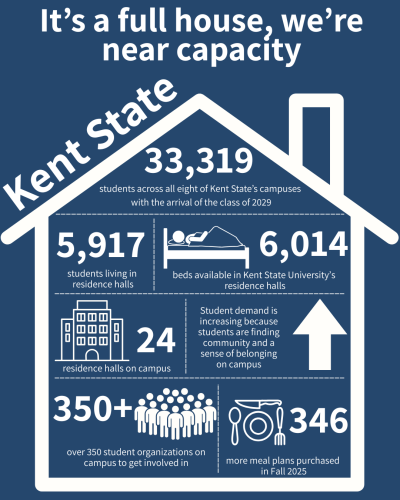
With the reopening of Verder Hall, the number of beds available on campus rose from 5,896 in the fall 2024 to 6,014 in the fall 2025. Of those beds, 5,917 were occupied for the Fall 2025 Semester.
For first-year speech pathology and audiology major, Brooklyn Nolletti, living on campus her first year has been more than helpful. Nolletti wanted a residence hall experience, not just because she is a first-year, but also because of the many benefits it offers.
The residence hall resources available on campus have also been helpful to Nolletti.
“I’ve never felt unsafe on the campus, I’ve always felt like if I need help, there are resources and people in my dorm hall in a similar situation that I can go to,” Nolletti said.
Resident assistant in the Centennial Court and senior aeronautics major Isabella Hinz agrees.
“I see the benefits and what I can take away from doing this; it was building community,” Hinz said. “So as an RA, you obviously engage with most students who live on campus.”
Resident assistants foster a sense of community within residence halls by organizing events and activities for students on their floors.
“I think in housing in general, we’re trying to do a lot better job with getting people connected socially. And I think that’s fantastic,” Hinz said.
Growing dining plan participation, which has increased by 346 meal plans this semester, points to another way students stay connected and fueled up.
Outside of the social benefits of living on campus, there are academic benefits as well.
“It’s a lot easier to go to your classes when you’re not worried about parking, your car not working or the winter weather. When you’re living on campus, you just walk right to your classes,” Hinz said.
A resource that is available to all students, not only those living in residence halls, are Peer Success Mentors. These student mentors work with students to build personal relationships, support academic success and foster a sense of belonging on campus.
Sophomore communication studies major and peer success mentor, Alex Gonzalez, believes the best thing about living on campus is the community.
Although academics are important, the sense of community on campus and in the residence halls allows students to bond and get to know each other, he says.

“If you’re only coming here for academics, you’re going to be bored. You’re not going to want to give 100 percent in all your classes,” Gonzalez said. “You also need to be social and have that as an outlet.”
Rising interest in housing, combined with student preference, is making the university look at its current housing options.
Jenkins explains that students want to live on campus and enjoy the experiences it offers, but they also want privacy.
“The majority of our residence halls were built in the late ’60s, with double beds and community bathrooms,” Jenkins said. “But students want single accommodation; they want to share a bathroom with fewer people. To be able to provide that effectively, we have to build new halls.”
For students like Nolletti, Hinz and Gonzalez, living on campus is more than a convenience; it’s where independence, friendship and opportunity meet. As Kent State looks to expand and improve its residence halls, the sense of belonging that defines campus life continues to thrive, one shared hallway at a time.