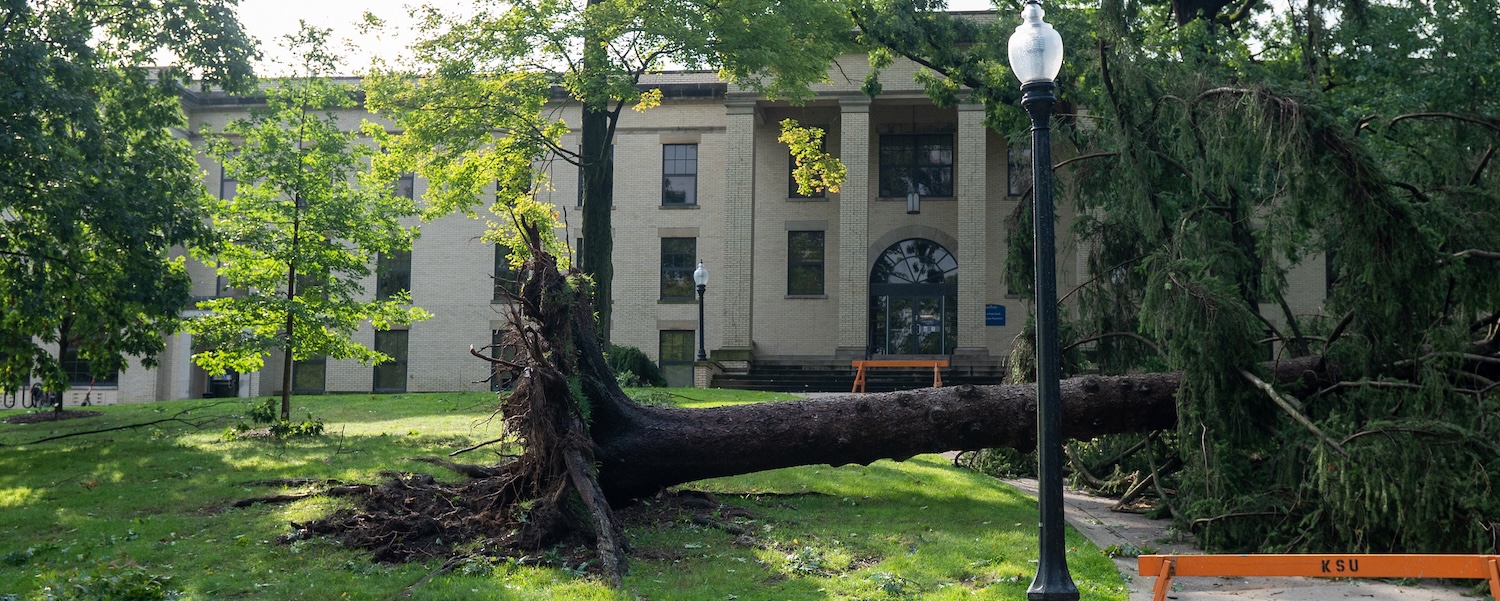
Campus grounds leaders are working to salvage trees removed due to storm damage, disease, the E. Main Street construction project and other causes, transforming them into a resource for future academic and beautification projects.
Leading the efforts is Freeland Southard, manager of FabLAB, and Pamela Evans, Professor Emerita of Interior Design in the College of Architecture and Environmental Design. The two say the idea grew from experience and a shared commitment to sustainability.
“Just noticing that there have been a lot of trees cut down annually, I saw an opportunity for a resource to be redirected back to the university,” Southard told Kent State Today.
Southard explained that the model for the project dates back to his graduate experience in Indianapolis, where a faculty member secured grant funding to hire an owner-operator to centralize logged trees. The logs were brought to a parking lot, staged, cut, sticker-stacked for drying and eventually redistributed back into the community.
A conversation with Evans helped move the idea forward.
“I thought this was a great idea,” Evans said. “I taught sustainability for 44 years; it just made sense to do this.”
With Evans on board, Southard pitched the idea to University Facilities Management.
“He expressed a strong interest in utilizing locally sourced materials, an effort that aligns naturally with the resources available on our campus,” said Rebekkah Berryhill, manager, Care of Grounds. “Additionally, he aimed to provide his students with hands-on learning opportunities in identifying suitable wood for various applications, as well as understanding the processes of milling and curing.”
After discussing the concept and pitching the idea to facilities management, the two visited a stack of logs on campus and began exploring how the wood could be saved for student and university projects.
So far, 13 logs were cut in the first round of milling, producing 600 board feet of red and white oak and 100 board feet of maple, with 30 more logs left to be milled. Any wood material that is not milled will be ground for mulch on campus.
The initiative is supported through a donation to the university’s Grounds Improvement Beautification Fund. Evans’ contribution helped launch the effort, while Southard coordinated much of the hands-on work.

Currently, there are no plans to continue after the initial donated funds are exhausted, but Southard hopes interest is generated to expand the effort.
“The long-term future of this initiative remains uncertain; however, I strongly support its continuation. It offers meaningful, hands-on educational opportunities for students and has the potential to enhance our campus environment,” Berryhill said.
For now, the wood is being processed and prepared for air drying, which should prevent shrinking, cracking and warping. This is expected to take about a year. Once ready, Southard and Evans hope it will serve as a shared academic resource across campus on a first-come, first-served basis.
They also envision a possible competition or campus-wide beautification initiative that would involve departments from across the university.
“The goal is to create a campus-wide effort that turns removed trees into a sustainable asset for the Kent State community,” Southard said.