
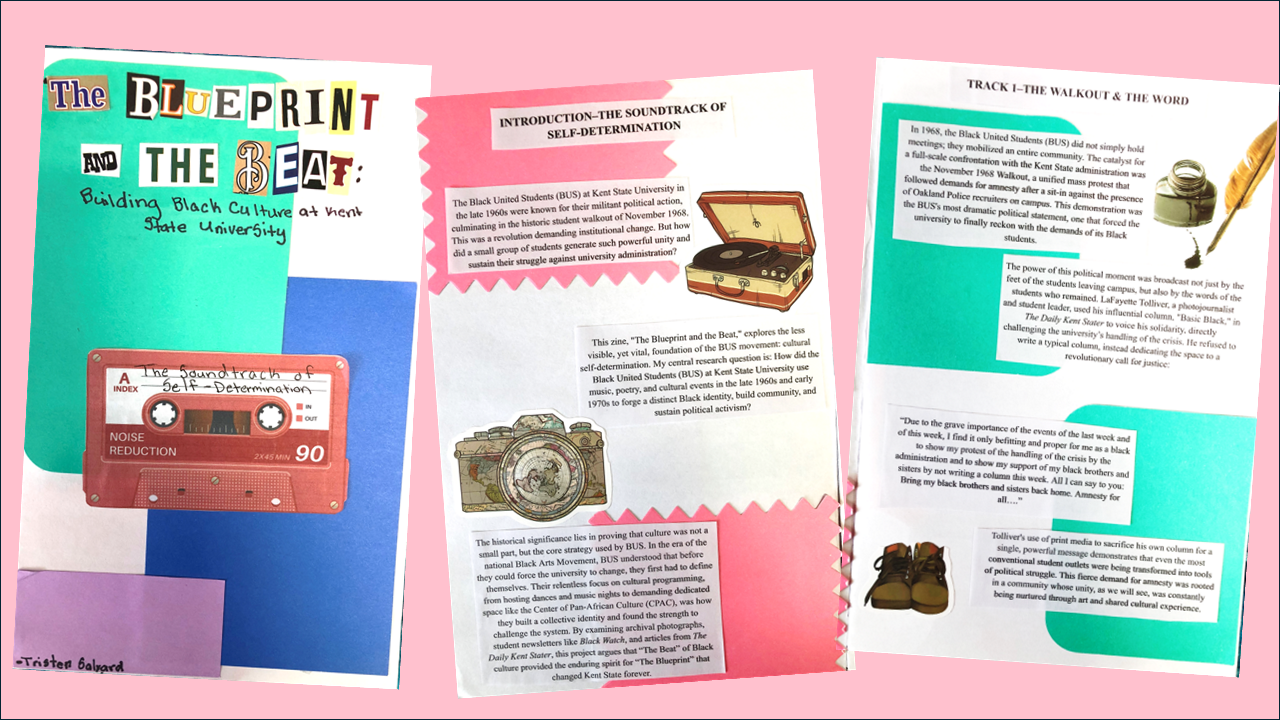
As a research department, we also put tremendous effort into the quality of our classroom instruction. Here we highlight some innovations from Dr. Liz Smith-Pryor (LSP), on her semester projects for undergraduates, as well as Dr. Kim Gruenwald (KG) and her classroom role-playing exercises.
LSP: So, I have my students do “Zines,” short for “magazine.” Sort of like a fan-zine and very popular in the 1990s. A kind of do-it-yourself, self-published thing. Originally grassroots and countercultural. I have students compose them in my class on the history of civil rights and black power, which I’ve been teaching since 2016. This history includes Kent State’s own Black Union of Students (BUS). This semester I also had them read a book about the Jackson State shooting, which includes the longer history of activism on that campus.
The final project is always something on Kent State and particularly Black students and their civil rights and Black Power activism. In previous semesters, it's been digital. This semester, I made a conscious choice to turn them into Luddites! The “Zine” is effectively a research project. They collect secondary sources, but also spend a couple of days in the Kent State Archives, working on the BUS papers there. All the usual paper-writing elements are there: a proposal, annotated bibliography, etc. It’s really just a different way of presenting one’s history research.
RSG: So, would you say that this is a primary source based research paper that takes multimedia form?
LSP: yes, that’s exactly what it is. Because they have to do all the same steps you do to write a research paper, but also making it multimedia, sort of scrapbooking it. There’s a DIY element there, that makes it more engaging.
One of Dr. Smith-Pryor’s students, Peyton DeForce, loved the assignment: “This was my first time making a zine and I am prouder of it (and had more fun doing it) than any essay I’ve ever written. It is a unique project that breaks from the mold of what I am used to in history, and I think it is a great tool that more instructors should use. I had a lot of fun making it and I hope to get assigned to make another one some time soon!”
Another student, Tristen Salyard, said “creating a zine about Kent State’s Civil Rights history showed me that research can be a deeply creative process. I loved the challenge of thinking outside the box by finding unique ways to layout essential information so that the final product was as visually engaging as the history itself.” The accompanying photos show Tristen’s final product!
Kim Gruenwald on her teaching: I use a roleplaying method, developed by a company called Reacting to the Past. In the fifteen week schedule of my classes, I devote ten weeks to lectures, and then five weeks to roleplaying. I still manage some primary source analysis as well during those first ten weeks.
RSG: So how do the students play this game?
KG: The students break into three or four factions. And then each faction has things that they're supposed to accomplish. For instance, for the Constitutional Convention roleplay, you've got a faction that wants the strongest national government possible; you’ve got a group that wants a constitution; you’ve got one where the states have more power; then, of course, a group that want no constitution, the anti-Federalists. So, to make it historically accurate the ones that don't want any constitution are always the smallest group. And the idea is that no one group can win their point of view without another. Nobody has over 50%, no matter how big their group is. The objective is to try to work out a solution among these different points of view. You have the main characters: George Washington and Hamilton and Madison. But there's also always somebody who's a faction leader, who has the most work. There’s voting, and convention procedure, and persuasion.
What I like is how it accommodates different personalities. For more outgoing students, there are the big roles. But there are also roles for shy students. The game also has a “flavor character” in each of the four groups. Like, if you're Benjamin Franklin, you have to have glasses. Then there's a character that carries around a brown paper bottle and drinks and says drunken things.
RSG: I was going to ask you, how much do the kids lean into these roles?
KG: I definitely get some “actors” who step up. But the point is that it’s supposed to be completely student-run. It becomes kind of like Colonial Williamsburg; enter the classroom, and you enter Philadelphia in 1787. You stay in character. Before long, they were playing the game before I even got there. Yes, I'm never doing another upper division again without it. I just love it. This company do other roleplaying games too, on topics like suffrage, labor rights, the Vietnam War and Watergate.