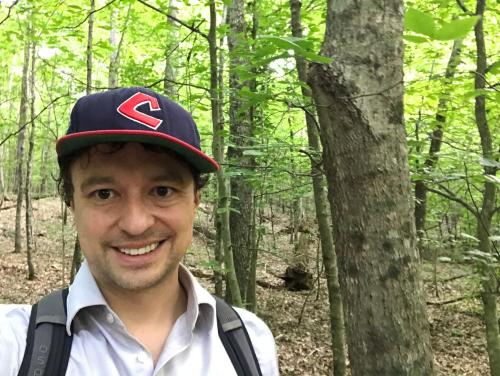

When Ryan Dezember walked into the Kent Stater newsroom as a freshman in 1999, he had a dream that probably sounded like wishful thinking. He was seeking a long career where the only thing he ever did for money was write.
A quarter century later, he's living it.
Dezember is a reporter at The Wall Street Journal, one of the most widely read financial news organizations in the world, where he has covered everything from the Deepwater Horizon oil spill to commodity markets. He's also the author of Underwater, a book that chronicles the 2008 housing crisis through the stories of ordinary homeowners — a copy of which now sits in libraries across the country.
His path ran through Kent State's School of Media and Journalism, a post-grad internship in the Journal's Washington bureau, seven years of crime, hurricanes, and government scandals at the Mobile Press-Register, and an early assignment that sent him back to Ravenna to map the Utica Shale.
We caught up with Dezember to talk about student media, newsroom survival, and what it really takes to get the career you want.
What drew you to Kent State?
A lot of people from my high school in suburban Cleveland went to Kent and so did my Aunt Erin and Uncle Gary, who are close to my age, so it was a familiar place. I wanted to pursue a journalism degree from the start, and I was drawn to the idea of living in a stereotypical college town. I also played in rock bands at the time, and Kent had a fantastic music scene, which sealed the deal.
What were some of your most memorable and meaningful student media experiences?
A couple of reporting assignments for the Stater stand out. I traveled to Washington, D.C., with a busload of anti-war protesters who joined a huge march on the Capitol. I got gassed with the crowd at one point but did manage to snap what wound up being an award-winning photo for the paper. On another trip classmate Brian Barr and I drove to West Virginia to meet a man who refused to move from a mountain that coal miners were eyeing. Back before Google Earth, the only way to see the ravages of the mountain-top removal mining that our host opposed was to fly above the massive pits. We arranged for a pilot to take us up in his propeller plane so that we could hold my old film camera out the window to take photos for our articles.
How did being part of Student Media prepare you for postgraduation life and the working environment?
The Stater was basically a professional newsroom. I walked in looking to get involved at the start of my second semester and was given a job right there and then proofreading. There were some really impressive people working there whom I really admired and learned from, including Andy Netzel, Chris Wetterich and Rachel Dissell. As a reporter, I learned to cover a beat, turn a short interview with an artist or celebrity into a news story on deadline and fight with police and other public officials for answers and public records. I tried my hand at editing during my senior year and got a great perspective on how to keep my future editors happy.
What were some of your favorite classes?
I considered all the writing and reporting classes intertwined with my paid jobs at the Stater and the Burr. I treated them like work more than school. In an academic sense, I loved photography classes. Literature classes were also a treat. Naturally, studying the great novels helped my writing. I enjoyed anthropology lectures so much that I wound up earning a minor in the subject.
How did coursework prepare you for where you are today?
Newswriting and reporting classes forced me to learn facets of reporting that I might have otherwise not pursued, which made me a well-rounded applicant for jobs. My clips ranged from crime to cultural events. Learning news photography gave me an edge when I went looking for a reporting job. The photos in my clips got the attention of an editor in southern Alabama who needed a reporter he could station at the beach, which was sometimes too far for a photographer to travel from the newsroom in Mobile. My comfort with a camera helped me clinch that first full-time reporting job.

Tell us about your career path.
I graduated after a summer internship at the Fort Wayne Journal-Gazette and then worked a post-grad internship at The Wall Street Journal's D.C. bureau. When that ended I took a part-time role writing for Northern Ohio Live back home in Cleveland while I hounded newspaper editors around the country for a reporting job. I spent about seven years in coastal Alabama with the Mobile Press-Register among a colorful cast, covering murders, government scandals, hurricanes, the 2008 housing bust and environmental calamities, including 2010's Deepwater Horizon oil spill. Later that year I joined The Wall Street Journal's Houston bureau to cover the oil-and-gas industry as the shale-drilling boom was kicking off. (An early assignment sent me to the land record office in Ravenna, where drillers were mapping out the Utica Shale.) After about a year I was transferred to New York, where I have reported on a number of topics in finance and markets, but mainly commodities, like oil, natural gas, copper and lumber.
What is your superpower?
Somehow avoiding the layoffs that have relentlessly shrunk newsrooms since the moment I stepped into one. It's a tragedy for America and I hope that some smart Kent State journalism students will figure out how to reverse the trend.
What do you consider to be your greatest accomplishment, personally and professionally?
I get a kick out of seeing my book, "Underwater," in libraries. But I'm most proud of my long career. Since the day I stepped off campus with my diploma I've never done anything for money except write. My career has gone pretty much exactly as I dreamt it could when I walked into the Stater office in 1999. I learned the ropes at a great daily newspaper in an exotic and exciting place with other young reporters. Now I have my dream job at The Wall Street Journal, where I have worked for more than 15 years. I feel like a kid who fantasized about playing pro ball and then wound up on the Yankees.
What advice do you have for students and recent graduates?
Don't be shy about participating in student media. The classroom instruction was great, but I learned how to do the job at the Stater. And when you decide what sort of job you want, act deliberately to get it. By that I mean, start doing it. Now! No one hires writers who aren't writing. Take what work in your field you can get, study the greats, be willing to leave your comfort zone and get ready to pounce when you get your chance.