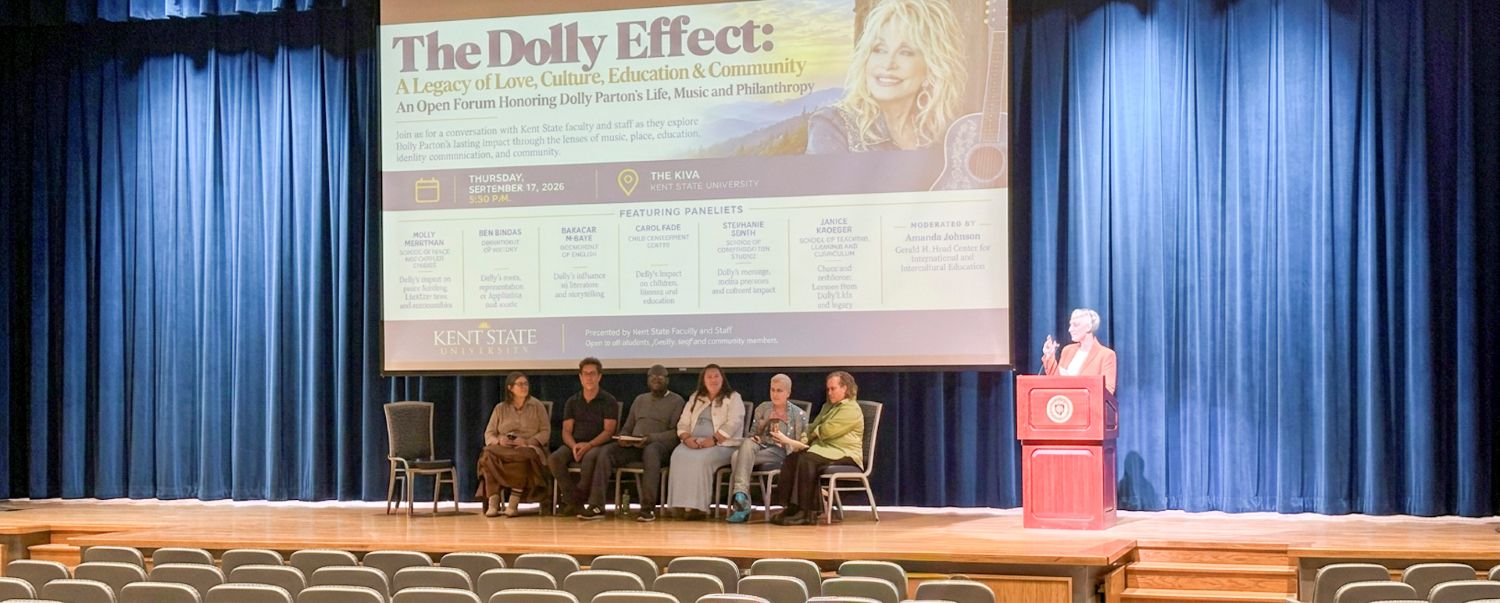
Six Kent State University scholars gathered to explore how Dolly Parton became one of America's most influential cultural figures — not just as a musician, but as a peacebuilder, educator and philanthropist.
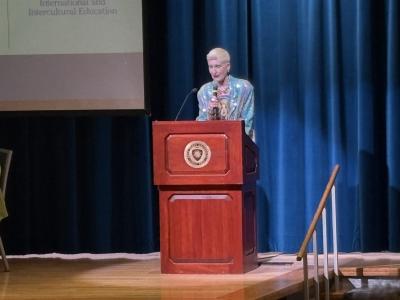
"She could talk about poverty without asking for pity," said Amanda Johnson, Ph.D., director of the Gerald H. Read Center for International and Intercultural Education and the forum's moderator. "She could talk about her family, her mountains, her accent, her faith without apologizing. Then she became one of the most recognizable people on the planet. But she never pretended to be somebody other than who she was."
The forum "The Dolly Effect: A Legacy of Love, Culture, Education and Community," held Sept. 17, brought together faculty from across the university to examine Parton's influence through the lenses of music, history, peace studies, communication and education.
From Poverty to Authenticity
Ken Bindas, Ph.D., a historian and professor in the Department of History, traced Parton's rise from a one-room cabin on the Little Pigeon River in East Tennessee, where she was born the fourth of 12 children in "dire poverty," to her emergence as a global icon.
"She kept her heavy accent, never left, never tried to lose it," Bindas said. "She kept her sense of high glamour and her feminine style."
Bindas said Parton remained loyal to her roots even as she achieved international fame — a distinction he said set country music apart from jazz, blues and rock 'n' roll, which moved away from their working-class origins.
Her business ventures reflected that commitment. Parton partnered with what was once a failing amusement park in East Tennessee, renamed it Dollywood and created a destination that "is about East Tennessee. It's about the South. It hasn't lost its identity, just like she hasn't lost her identity," Bindas said.
Dolly as Literature and Storytelling
Babacar M'baye, Ph.D., professor in the Department of English, approached Dolly's work from an African perspective, drawing parallels to the literary traditions of the American South. M'baye, a native of Senegal who specializes in American studies, described first hearing Dolly's voice and being struck by its power.
"I've never heard a voice like this," M'baye recalled. "The only moment I remember hearing a voice like this was when I was listening to someone from my tape player at home, and my grandmother said, 'That person has a golden voice.'"
M'baye said Parton's songs function as literature — complete with vivid characters, dialogue, metaphors and social commentary. "When you listen to Dolly, you are watching a movie," he said. "You have a clear depiction of characters. You have light. You have darkness. You have hope. You have all the elements that go into a great literary text.
"Dolly captures the life of the poor, you know, during dire times," M'baye said, noting that her songs transcend region and race to speak to universal human experience.
Building Peace Through Love
Molly Merryman, Ph.D., associate professor in the School of Peace and Conflict Studies, highlighted Parton's LGBTQ advocacy decades before it became mainstream. In the 1980s, when few in entertainment acknowledged HIV and AIDS, Parton spoke openly about the crisis.
"She managed to talk about very challenging topics in ways that were done with love and brought people together," Merryman said.
Merryman cited Parton's employment of LGBTQ people and her decision to provide gender-affirming care for her chauffeur long before most workplaces offered such support. When Parton died, President Donald Trump ordered flags lowered to half-staff, an honor that "spoke beyond the culture wars that we live in," Merryman said.
"She has been a role model," Merryman added. "She has been of value to me, and I love her."
The Paradox of Dolly
Stephanie Smith, senior lecturer in the School of Communication Studies, described Parton as an "American paradox" — simultaneously optimistic and realistic, spiritual yet never preachy.
"She was her own influencer," Smith said, noting Parton's control over her image and message. The singer "deliberately foregrounded" her sexuality and "was fully in control of the script," Smith said.
Smith said Parton's cultural impact transcended country music. Her work spanned rock, gospel and pop music, as well as film, television and merchandise. Her business empire included theme parks, dinner theatres and merchandise ranging from pet products to coffee beans.
"Her largest impact was that she was a cultural inspiration," Smith said. "She reminds us that we are all capable of American grit and American grace — the ability to treat all people, and especially ourselves, with kindness, good humor and dignity."
Smith quoted Parton: "Never ignore your roots, your home or your hair."
Books and Literacy
Carol Fade from Kent State's Child Development Center highlighted Parton's Imagination Library, launched in 1995 after Parton learned her father was illiterate. The program has distributed more than 330 million books to more than 3 million children across five countries.
"The literacy gaps were closed for the children that were in her program," Fade said, citing international research. The free program also "strengthened home literacy environments" and encouraged families to read together.
"She's given families the opportunity to spend five to 10 minutes of real quality time together," Fade said. "In this busy world where we're all in such a hurry, I really believe that is truly the best gift Dolly could have given any of us."
Transforming Adversity
Janice Kroeger, Ph.D., professor in the School of Teaching, Learning and Curriculum Studies, described Parton as a "transformer" who took the chaos and poverty of her childhood and "transmuted it into art, business acumen and generosity."
Parton never sang alone and never made money solely for herself, Kroeger said. Instead, she "channeled that back into her community," singing with artists including Freddie Mercury, Beyoncé and Sting.
Kroeger urged attendees to adopt Parton's resilience in their own lives.
"We cannot control the instability of the chaos," Kroeger said. "But within our actions toward others, the way that we think, we can control our circumstances and outcomes. We can lift each other up."
She concluded: "Be like Dolly."
Parton was born Jan. 19, 1946, in a one-room cabin in Sevier County, Tennessee. She made her debut at the Grand Ole Opry at age 13 and went on to win 11 Grammy Awards and numerous Country Music Association Awards.
She was inducted into the Country Music Hall of Fame in 1999 and the Rock & Roll Hall of Fame in 2022. Her signature songs include "Jolene," "9 to 5" and "I Will Always Love You."
Parton died Aug. 25, 2026, at age 80 after a brief battle with cancer.