
Research Experiences for Undergraduates
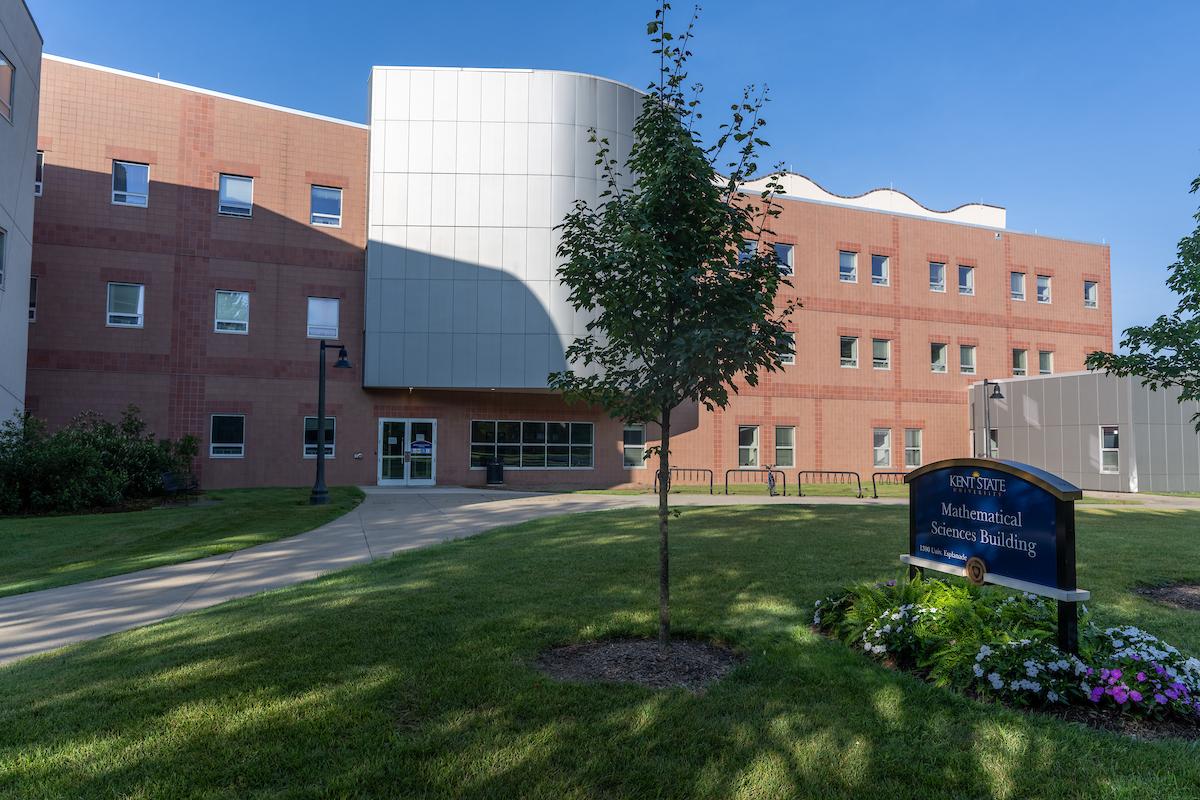
The Department of Mathematical Sciences at Kent State University will run an NSF-funded REU program from June 1 through July 23, 2027. Students will work on projects arising naturally in our faculty's research. The emphasis of the program is on independent work under close supervision of the project advisor.
CONTACT
Jenya Soprunova: esopruno@kent.edu, Mark Lewis: mllewis@kent.edu
Eligibility
To be eligible you must
- Be a US citizen or a permanent resident (Note: We will not be able to accept international students even if they pay for their housing.)
- Be an undergraduate student prior to the program start
- Not graduate by September 2027
Stipend, Room, and Travel
The students will receive $5,600 toward stipend and expenses. We will provide free on-campus housing and will pay up to $400 for travel expenses.
Selection Criteria
For our Summer 2027 program, we will select nine participants based on their completed coursework and grades, the list of courses they plan to take in the spring semester, a letter of recommendation from a faculty member familiar with their work, and a personal statement. We expect applicants to have completed a calculus sequence, a linear algebra course, and at least one advanced upper-division mathematics course (e.g., abstract algebra or analysis).
Many undergraduate students already have this background or a similar one after their freshman year, and we encourage them to apply. We welcome applicants from all backgrounds and do not discriminate on the basis of race, color, religion, sex, gender identity, sexual orientation, national origin, age, or disability. We encourage participation by underrepresented groups but will not give preference based on race, ethnicity, or gender.
For Summer 2027 we will recruit nine students to work on the three projects described below.
Graphs and groups (Mark Lewis)
There are several graphs naturally associated with groups. In this project, we will focus on the commuting graph and the closely related centralizer graph of a group G.
The commuting graph has as its vertex set the noncentral elements of G, with an edge between two vertices g and h whenever gh=hg. The centralizer graph has as vertices the centralizers C_G(g) of noncentral elements g in G. Two vertices C_G(g) and C_G(h) are connected by an edge whenever Z(C_G(h)) is contained C_G(g).
Recall that the diameter of a connected component of a graph is the largest distance between any two vertices in that component, where the distance between two vertices is the length of the shortest path connecting them.
In this project, we consider the commuting graphs of solvable groups. Parker has proved that if G is a solvable group whose center is trivial then the commuting graph of G is connected if and only if G a Frobenius group or a 2-Frobenius group. And in this case, when the commutating graph is connected, then its diameter is at most 8.
On the other hand, when G is not solvable and the center of G is not trivial, we know we obtain disconnected graphs when G has a maximal centralizer that is abelian or a centralizer that either contains or intersects trivially all other centralizers. One goal is to determine if there are any other sufficient conditions on the group structure that yield that the centralizer graph will be disconnected and ideally lead to a necessary sufficient condition if possible.
Regarding the diameter, Guidici and Parker have shown that there exists a family of two groups with arbitrarily large diameters on their commuting graphs. We would like to explore if we can bound the diameter of connected commuting graphs of solvable groups that are not nilpotent either by a universal constant or by a function in terms of the number of terms in the upper central series. As a first step, can we bound the diameter of commuting graphs of solvable groups where the second center equals the center and the center is nontrival?
Prerequisites: At least one semester of undergraduate Abstract Algebra.
References:
- Peter J. Cameron, Graphs on Groups: An Indian Adventure, Lond. Math. Soc. Newsl. No. 513 (2024), 22–25.
- Peter J. Cameron, Graphs defined on Groups, Int. J. Group Theory 11 (2022), no. 2, 53–107.
- Rachel Carleton and Mark L. Lewis, The Commuting graph of a solvable A-group, J. Group Theory 28 (2025), no. 1, 165–178.
- Nicholas F. Bieke, Rachel Carleton, David G. Costanzo, Colin Heath, Mark L. Lewis, Kaiwen Lu, and Jamie D. Peare, Extending results of Morgan and Parker about commuting graphs, Bull. Aust. Math. Soc. 105 (2022), no. 1, 92–100
Differential Equations and Applications (Fedor Nazarov and Peter Gordon)
The project will be devoted to questions concerning the qualitative behavior of the solutions of differential equations that have completely elementary formulations, yet are only partially analyzed. These equations originate from several applications from physics, biology, and convex geometry and most likely require a fresh look rather than more advanced technical skills. Both the analytical and the numerical approaches may be explored.
Possible project related to biological applications will involve analysis of large solutions for a certain ordinary differential equation which appears in the analysis of the dynamics of morphogen gradient in the developing cell [1].
An example of a physically motivated problem is the analysis of a model of thermal explosion in porous reactive media. The model was derived and partially analyzed in [2] and consists of a boundary value problem for a system of two parabolic equations. A possible project may involve the study of various parametric regimes the system can exhibit.
A typical convex geometry example is as follows. Let K be a bounded convex body. The body of flotation of K is a convex body obtained by cutting off K all caps of fixed volume by hyperplanes. Assume that the body of flotation F of K is a ball. Does it mean that K is a ball itself? In case when K is a body of revolution and, in addition, the centers of mass of caps lie on a sphere with the same center as F, the problem can be reduced to a system of differential equations in even dimensions. The problem has been fully analyzed in dimensions 2 and 4, but still remains open even in dimension 6. See [3] for more details.
- [1] P.V. Gordon, C.B. Muratov, Eventual self-similarity of solutions for the diffusion equation with nonlinear absorption and a point source, SIAM J. Math. Anal., 47(4) (2015), 2903-2916
- [2] P. Gordon, On thermal explosion in porous media, Nonlinearity 23 (2010), 1433-1447
- [3] M.A. Alfonseca, D. Ryabogin, A. Stancu, V. Yaskin, On questions of uniqueness of Croft, Falconer and Guy for bodies of revolution, Pure and Appl. Func. Analysis, 10(5) (2025),1133–1159.
Directions of equilibrium of floating bodies (Dmitry Ryabogin).
The project is about finding the directions of equilibrium positions of solid convex bodies of uniform density submerged into water.
The body K made of uniform density D∈(0,1) submerged into water of density 1 is said to float in equilibrium in a given orientation if the line passing through its center of mass and the center of mass of its underwater part is orthogonal to the water surface. In other words, if the Gravity force acting down on the center of mass of the body balances off the Archimedes force acting up on the center of mass of its underwater part.
If the submerged bodies are orthogonal prisms with sections being a regular plane n-gon, with the generator parallel to the water surface, this essentially 2-dimensional problem was solved in the 19th century. It was proved that the 4n-gonal prism has at most 4n directions of
equilibrium. In particular, one can show (try to do it! this is a very hard elementary geometry high school problem, see [1] below) that a regular triangle has 12 or 6 such directions depending on the density of the triangle (the prism).
A general polytope might have infinitely many directions of equilibrium, so one has to count them properly, up to the symmetry.
In this project, we will try to find and make a description of the equilibrium positions of simplices, cubes, octahedra and other bodies
(see [2] for some information).
References:
- [1] "On flotation, stability and related questions: A survey", (with M.
Alfonseca, A. Stancu and Vlad Yaskin), to appear in New Probes into
Discrete and Convex Geometry (J. Pach and G. Toth, eds.), Bolyai Society
Mathematical Studies, Vol. 32, Springer-Verlag, Berlin. - [2] E. N. Gilbert, How Things Float, American Mathematical Monthly, 98:3
(1991), 201-216. - [3] P. Erdös, G. Schibler and R. Herndon, Floating equilibrium of
symmetrical objects and the breaking of symmetry. Part 1: Prisms, Am. J. Phys.60 (1992), 335—345.P. Erdös, G. Schibler and R. Herndon, Floating equilibrium of symmetrical objects and the breaking of symmetry. Part 2: Prisms, Am. J. Phys. 60 (1992), 345—356.
Application Deadline: Friday February 12, 2027
The application is available at https://etap.nsf.gov/award/8301/opportunity/11688.
To complete your application, you will be asked to provide the following:
- CV or Resume
- A personal statement (3-5 paragraphs) describing your interest in mathematics, relevant background, prior research experience (if any), and career goals. You will also be asked to describe your experience in the most advanced math course you have taken;
- A response indicating which of the three projects you are most interested in and why;
- Unofficial college transcript including Fall 2026 semester;
- Contact information for two references. They will receive an email with instructions for submitting a reference form through the system. Please speak with your letter writers before entering their email addresses. We recommend requesting letters from mathematics instructors, especially those who have taught your most advanced courses, or from mentors who supervised a research project in which you participated.
- Nicolas F. Beike, Rachel Carleton, David G. Costanzo, Colin Heath, Mark L. Lewis, Kaiwen Lu, and Jamie D. Pearce, Finite solvable tidy groups whose orders are divisible by two primes, São Paulo J. Math. Sci. 18 (2024), no. 2, 1651–1669.
- David G. Costanzo, Mark L. Lewis, Stefano Schmidt, Eyob Tsegaye and Gabe Udell, Characterizing finite groups whose enhanced power graphs have universal vertices, Czechoslovak Math. J. 74(149) (2024), no. 2, 637–645.
- Abdulrahman Alajmi, Sayok Chakravarty, Zachary Kaplan, and Jenya Soprunova, Lattice size in higher dimensions, Involve, a Journal of Mathematics 17-1 (2024), 153--162.
- Nicolas F. Beike, Rachel Carleton, David G. Costanzo, Colin Heath, Mark L. Lewis, Kaiwen Lu, and Jamie D. Pearce, Finite solvable tidy groups are determined by Hall subgroups with two primes, Bull. Aust. Math. Soc. 109 (2024), no. 2, 342-349.
- Nicolas F. Beike, Rachel Carleton, David G. Costanzo, Colin Heath, Mark L. Lewis, Kaiwen Lu, and Jamie D. Pearce, p-groups with cyclic or generalised quaternion Hughes subgroups: classifying tidy p-groups, Bull. Aust. Math. Soc. 108 (2023), no. 3, 443-448.
- Nikita Borisov, Hayden Julius and Martha Sikora, On maps preserving square roots of idempotent and rank-one nilpotent matrices, J. Algebra Appl., 21, No. 06, (2022), 2250123.
- Nicolas F. Beike, Rachel Carleton, David G. Costanzo, Colin Heath, Mark L. Lewis, Kaiwen Lu, and Jamie D. Pearce, Extending results of Morgan and Parker about commuting graphs, Bull. Aust. Math. Soc. 105 (2022), no. 1, 92–100.
- David G. Costanzo, Mark L. Lewis, Stefano Schmidt, Eyob Tsegaye and Gabe Udell, The cyclic graph of a Z-group, Bull. Aust. Math. Soc., Bull. Aust. Math. Soc. 104 (2021), no. 2, 295–301.
- David G. Costanzo, Mark L. Lewis, Stefano Schmidt, Eyob Tsegaye and Gabe Udell, The cyclic graph (deleted enhanced power graph) of a direct product, Involve 14 (2021), 167--179.
- Kyle Meyer, Ivan Soprunov, Jenya Soprunova,On the number of F_q-zeros of families of sparse trivariate polynomials, SIAM Journal on Applied Algebra and Geometry 6, No 3 (2022), 432-467.
- Anthony Harrison, Jenya Soprunova, Patrick Tierney, Lattice size of plane convex bodies, SIAM J. Discrete Math. 36, No 1 (2022), 92-102.
- Louisa Catalano and Megan Chang-Lee, On maps preserving rank-one nilpotents, Linear and Multilinear Algebra, 69(16) (2021), 3092–3098.
- Aria Beaupre, Emily Hoopes-Boyd and Grace O'Brien, On the images of generalized polynomials evaluated on matrices over an algebraically closed skew field, Linear Algebra Appl. 610 (2021), 827--836.
- Steven Jin and Jooyoung Shin, Iterated differential polynomial rings over locally nilpotent rings, Comm. Algebra 49 (2021), 256--262.
- Victor Ginsburg, Hayden Julius and Ricardo Velasquez, On maps preserving Lie products equal to a rank-one nilpotent, Linear Algebra Appl. 593 (2020), 212--227.
- Louisa Catalano and Megan Chang-Lee, On the connection between differential polynomial rings and polynomial rings over nil rings, Bull. Aust. Math. Soc., 101 (2020), 438--441.
- Fei Yu Chen, Hannah Hagan and Allison Wang, On differential polynomial rings in several variables over locally nilpotent rings, Int. J. Algebra Comp. 30 (2020), 117--123.
- Fei Yu Chen, Hannah Hagan and Allison Wang, On skew polynomial rings over locally nilpotent rings, Comm. Algebra, 47 (2019), 1102--1104.
- Jeffrey Okamoto, Natasha Stewart, Jun Li, HDcpDetect: detect change points in means of high dimensional data, R Package Version 0.1.0, 2018.
- Louisa Catalano, Samuel Hsu and Regan Kapalko, On maps preserving products of matrices, Linear Algebra Appl. 563 (2019), 193--206.
- William Clark, Andrew Ahn, Shahaf Nitzan and Joseph Sullivan, Density of Gabor systems, J. Fourier Anal. Appl., 24 (2018), 699--718.
- Alexander Ma and Jamie Oliva, On the images of Jordan polynomials evaluated over symmetric matrices, Linear Algebra Appl. 492 (2016), 13--25.
- Cailan Li and Man Cheung Tsui, On the images of multilinear maps of matrices over finite-dimensional division algebras, Linear Algebra Appl. 493 (2016), 399--410.
- Katherine Cordwell and George Wang, Multilinear polynomials of small degree evaluated on matrices over a unital algebra, Linear Algebra Appl. 496 (2016), 262--287.
- Sarah Manski, Jacob Mayle, Nathaniel Zbacnik, The Asymptotic Distribution of a Hybrid Arithmetic Function, INTEGERS, 15 (2015), A28, 16 pages.
- Benjamin Anzis, Zachary Emrich, Kaavya Valiveti, On the images of Lie polynomials evaluated on Lie algebras, Linear Algebra Appl. 469 (2015), 51--75.
- Michael Kaufman and Lillian Pasley, On commutators of matrices over unital rings, Involve 7 (2014), 769--772.
- David Buzinski and Robin Winstanley, On multilinear polynomials in four variables evaluated on matrices, Linear Algebra Appl., 439 (2013), 2712--2719.
- James Moody, Corey Stone, David Zach, and Artem Zvavitch, A Remark on the Extremal Non-Central Sections of the Unit Cube, Asymptotic Geometric Analysis, Fields Institute Communications, 68 (2013), 221--229.
- Olivia Beckwith, Matthew Grimm, Jenya Soprunova, and Bradley Weaver, Minkowski length of 3D lattice polytopes, Discrete and Computational Geometry, 48 (2012), 1137--1158.
- Thomas Dinitz, Matthew Hartman, and Jenya Soprunova,Tropical Determinant of Integer Doubly-Stochastic Matrices, Linear Algebra Appl., 436 (2012) 1212--1227.
- Toan Duc Dinh and Michael Donzella, On maps preserving zeroes of Lie polynomials of small degree, Linear Algebra Appl., 432 (2010), 493--498.
REU 2009
Students: Toan Duc Dinh, Michael Donzella, Thomas Dinitz, Matthew Hartman, Lizbee Collins-Wildman, Matthew Hoffman, Benjamin Mackey, Catherine Pizzano
Advisors: Mikhail Chebotar, Jenya Soprunova, Andrew Tonge, Laura Smithies
REU 2010
Students: James Moody, Corey Stone, David Zach, Bren Cavallo, Lynne DeYoung, Matthew Alexander, Sarah Mullin, Hannah Yee, Olivia Beckwith, Matthew Grimm, Bradley Weaver
Advisors: Artem Zvavitch, Laura Smithies, Dmitry Ryabogin, Jenya Soprunova
Graduate Students: John Hoffman, Michelle Cordier
REU 2011
Students: Ian Barnett, Benjamin Fulan, Candice Quinn, William Kanegis, Zhiyuan Lu, Peggy Sah, Bradley Weaver, Amy Beard, Emily Heath, Andrew Zeller
Advisors: Morley Davidson, Don White, Steve Gagola, Jenya Soprunova
Graduate Students: John Hoffman, Michelle Cordier, Galyna Livshyts
REU 2013
Students: David Buzinski, Michael Kaufman, Lillian Pasley, Robin Winstanley, Rachel Carleton, Dorothy Klein, Hope Snyder, Ryann Cartor, Riley Burkart, Kyle Meyer, Cody Stockdale
Advisors: Misha Chebotar, Andrew Tonge, Jenya Soprunova
Graduate students: Michelle Cordier, John Hoffman, Matt Alexander.
REU 2014
Students: Zachary Emrich, Benjamin Anzis, Kaavya Valiveti, Sarah Manski, Jacob Mayle, Nathaniel Zbacnik, William Clark, Andrew Ahn, Joseph Sullivan
Advisors: Misha Chebotar, John Hoffman, Gang Yu, Shahaf Nitzan
Graduate students: Michelle Cordier, Mike Doyle, Matt Alexander
REU 2015
Students: Alex Ma, Jamie Oliva, Cailan Li, Man-Cheung Tsui, Katherine Cordwell , George Wang, Emma Cinatl, Margaret Allardice, Patrick Tierney
Advisors: Misha Chebotar, Jenya Soprunova
Graduate students: Anthony Harrison, Matt Alexander, Isaac Defrain
REU 2018
Students: Natasha Stewart, Jeffrey Okamoto, Zachary Kaplan, Sayok Chakravarty, Hannah Hagan, Regan Kapalko, Fei Yu (Dennis) Chen, Allison Wang, Samuel Hsu
Advisors: Misha Chebotar, Jun Li, Jenya Soprunova
Graduate students: Abdul Alajmi, Louisa Catalano, Anna Levina, Tomas Rodriguez
REU 2019
Students: Victor Ginsburg, Megan Chang-Lee, Ricardo Velasquez, Eyob Tsegaye, Gabriel Udell, Stefano Schmidt, Isabelle Hauge, Molly Noel, Olivia Beck
Advisors: Misha Chebotar, Mark Lewis, Jun Li
Graduate students: Louisa Catalano, Emily Hoopes, David Costanzo, Hayden Julius