
David H. Smith Conservation Research Fellowship
Kent State University Ecology and Evolutionary Biology graduate student Prashant Ghimire has been selected for the highly competitive David H. Smith Conservation Research Fellowship, one of the nation’s premier postdoctoral programs supporting early-career leaders in conservation science. Ghimire will begin the fellowship following his graduation from Kent State University in August 2026.
Ghimire’s project “Echoes from the Prairie: Developing Conservation Solutions for Declining Grassland Birds in North America” will be conducted at Colorado State University as part of the David H. Smith Conservation Research Fellowship program. He was selected as one of seven in the 2026 cohort earlier this spring.
This prestigious annual Fellowship is made possible through the longstanding support of the Cedar Tree Foundation. Additional funding from Allen Family Philanthropies through partnership with the Society for Conservation Biology made it possible to expand the incoming class to be the largest one yet.
Kent State’s Impact on Ghimire
Ghimire successfully defended his doctoral dissertation “Molecular basis of high-altitude adaptation in birds” in May 2026 after completing a highly productive tenure in Dr. Sangeet Lamichhaney’s OMICS Lab in the Department of Biological Sciences.
In August 2021, he joined the Lamichhaney Lab for his PhD after completing a Bachelor of Science in Forestry at Tribhuvan University in Nepal. During his doctoral training, Ghimire developed expertise in molecular ecology, evolutionary genomics, and OMICS-based approaches to understanding adaptation in wild bird populations.
Dr. Lamichhaney highlighted Prashant’s unique trajectory and interdisciplinary strengths:
“Prashant arrived from Nepal with a strong foundation in field ornithology and hands-on natural history skills, which he has seamlessly integrated with advanced genomic and computational approaches during his PhD training in my lab. He has developed into a scientist who is equally strong in field biology, laboratory work, and computational genomics. This rare combination of skills makes him exceptionally well prepared to become a leading researcher in evolutionary and conservation genomics in the future.”
“Working with Dr. Lamichhaney has been not only scientifically rewarding, but also genuinely enjoyable. I joined his lab with a strong background in field ecology, and during my time at Kent State I gained training in cutting-edge molecular and bioinformatics techniques that fundamentally expanded my approach to research. Just as importantly, I developed an evolutionary perspective that now forms a central foundation of my proposed project,” said Ghimire.
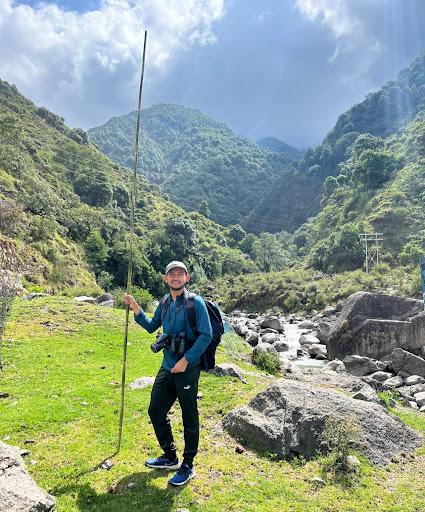
During his PhD, Ghimire studied how organisms survive in the extreme high-altitude environments of the Himalayas. His work combined extensive field sampling with molecular approaches to understand how birds adapt and persist in regions where complex geography constrains movement, rapidly changing environments create novel ecological pressures, and low-oxygen conditions challenge survival.
“My training at Kent State’s Department of Biological Sciences equipped me to pursue ambitious, integrative research that bridges ecology and evolutionary biology to address pressing conservation challenges,” shared Ghimire.
Achievements Within and Beyond Our Campus
Ghimire has presented his doctoral research at many local, national, and international conferences, earning a best graduate student presentation award at the American Ornithological Society conference in 2022. During his time at Kent State, he published 14 papers, including five directly stemming from his PhD research in Dr. Lamichhaney’s’s lab. Overall, he has authored more than 30 publications, reflecting both the productivity and broad impact of his research. He has received multiple domestic and international travel awards from the KSU Graduate Student Senate and the American Ornithological Society; Graduate Student Leadership and Teaching Assistantship awards from KSU Department of Biological Sciences; The People’s Choice Award in the 2022 Flash Pitch Competition at KSU; and 2024 University Fellowship for Excellence in Research and Scholarship, 2025 David M. Smith scholarship, and 2026 Richard Bower’s dissertation fellowship from Kent State University.
During his time at KSU, in addition to his research, he was a teaching assistant for Biological Diversity and Ornithology laboratory courses, an instructor for the Upward Bound TRIO program, and a guest lecturer in genomics and ornithology courses. He has also held several leadership positions within the American Ornithological Society and mentored at least a half dozen undergraduate students on their independent research projects.
ESDRI Graduate Student Award
One of Ghimire’s latest awards was from Kent State’s Environmental Science and Design Research Institute. His ESDRI Graduate Student Award project, “Altitudinal Migrants on the Edge: Evolutionary Relationships and Molecular Basis of High Altitude Adaptation,” investigated the evolutionary relationships and population genetic structure of Black Redstart (Phoenicurus ochruros) across Asia and Europe. In this work, he proposed developing the Black Redstart as a model system to study how birds colonize new environments, diversify, and adapt to extreme high-altitude environments across continents. This work yielded several significant outcomes, including the first resolution of the taxonomic relationship among four redstart species using whole-genome sequencing. Contrary to prior expectations, the study also revealed unexpectedly high levels of genetic divergence among these species.
Furthermore, the study also conducted broader inference across a different high-altitude lineage with distinct demographic history and ecological context. Using Tibetan Partridge as a study system, the study demonstrated that both biogeography and climate jointly shape patterns of local adaptation and population divergence across the Himalayan–Tibetan mountain region. The work was subsequently published in Molecular Ecology, providing a more general framework for understanding how environmental gradients and geographic structure interact to drive evolution in alpine birds.
“The ESDRI award provided Prashant with an important opportunity to expand his doctoral research beyond a single focal system and develop a broader comparative framework,” said Dr. Lamichhaney. “It enabled him to integrate additional high-altitude species and strengthen the evolutionary and ecological scope of his work, ultimately allowing him to address more complex questions about adaptation and diversification across mountain systems.”
“Fieldwork in remote high-altitude regions and genome sequencing are logistically challenging. Support from the ESDRI award has allowed us to expand our sampling efforts and generate additional genomic data for our ongoing project,” added Ghimire.
This work was also featured in Kent State Today: New Study Reveals How High-Altitude Birds Adapt to Life on the 'Roof of the World'.
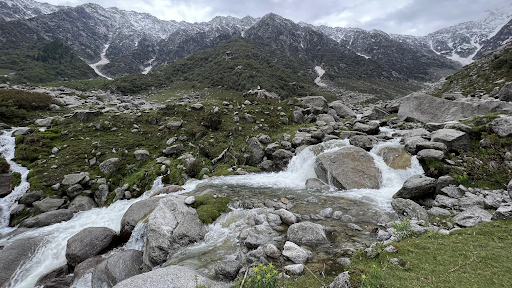
Striving for Broader Impacts with Science Communication
Ghimire has a strong passion for science communication and enjoys both sharing his work in various oral and written mediums and helping others to do so. He is deeply passionate about science communication and believes that science has the greatest impact when it is accessible, collaborative, and connected to communities. Beyond his research, he actively shares scientific knowledge through talks, blogs, mentoring, and public engagement initiatives.
While Ghimire has trained undergraduate researchers in developing their scientific ideas and communication skills, his outreach efforts also extend beyond academia. Ghimire has worked with more than 25 grassroots communities to educate, engage, and empower local people for biodiversity conservation. Through these collaborations, he aims to bridge the gap between scientific research and community knowledge.
“Conservation is only possible when science is connected to the lived realities of society. Too often, research and decision-making happen far from the communities most closely tied to nature. Lasting biodiversity conservation requires trust, collaboration, and local leadership alongside scientific research,” said Ghimire.
This belief inspired his outreach campaign, Science and Community Together, which focuses on building dialogue between researchers and local communities while promoting conservation awareness, scientific literacy, and inclusive participation in environmental stewardship.
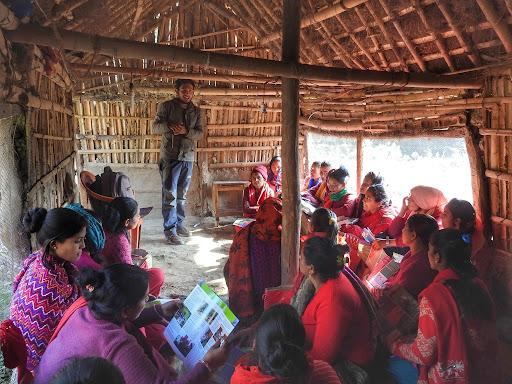
Ghimire’s Smith Fellowship project builds on this ground, where he strives to generate scientific evidence on grassland bird decline and co-produce practical conservation tools with local stakeholders.
We extend our best wishes to Prashant Ghimire as he begins the David H. Smith Conservation Research Fellowship and continues his career in evolutionary and conservation science.