
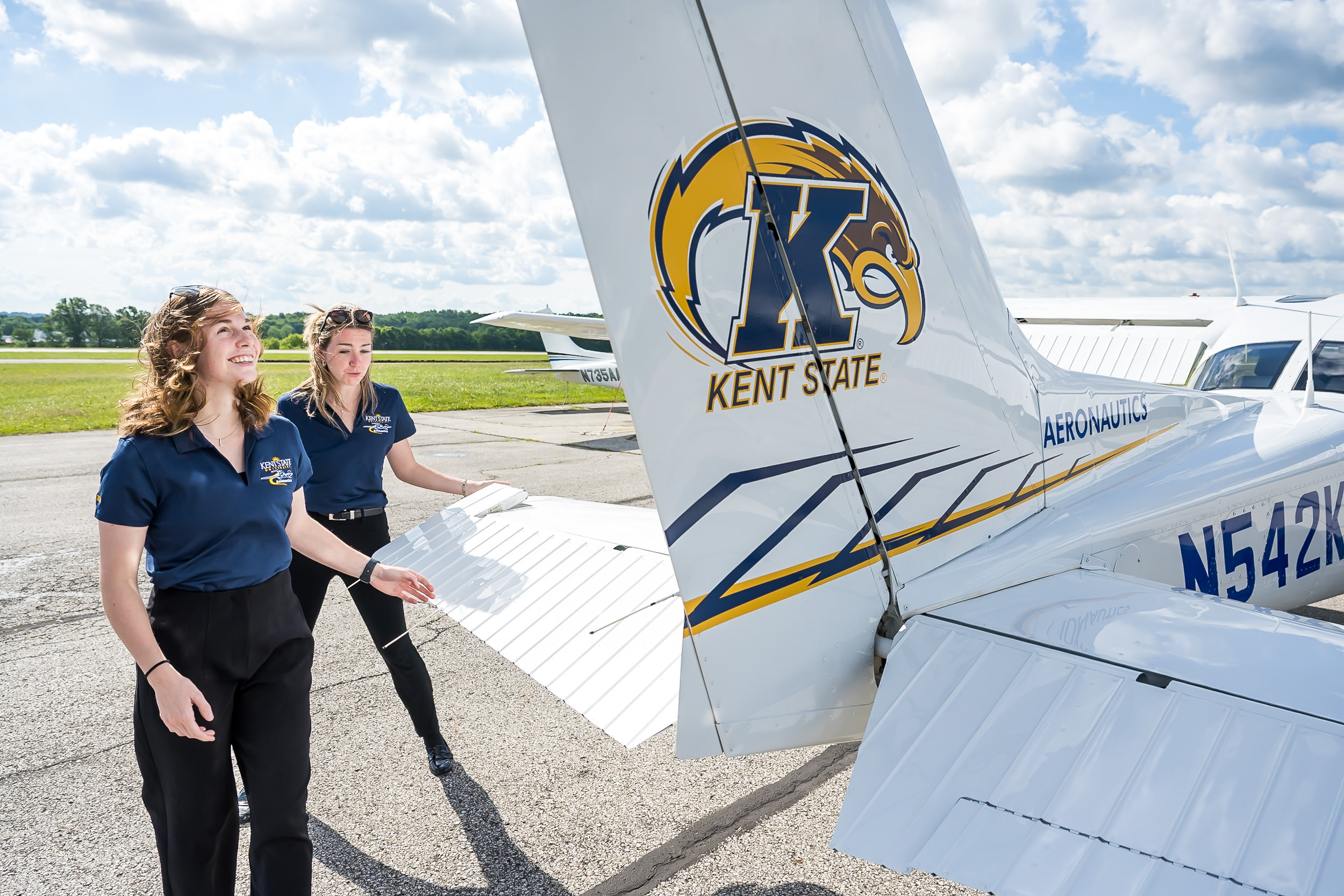
Two Kent State University flight teams pushed through six of the nine legs of the 2026 Air Race Classic before a stretch of stubborn, unpredictable weather brought their race to an early end.
The Air Race Classic is the longest-running all-women pilots’ cross-country race in the United States, and this year’s running marked its 49th annual competition. The 2026 course spanned roughly 2,400 nautical miles, starting at St. Louis Regional Airport in East Alton, Illinois, and finishing at Mount Vernon Airport, also in Illinois. The route included stops in Kentucky, South Carolina, Georgia, Alabama, Mississippi, Arkansas, Missouri and Wisconsin.
According to their coaches, Brian Neff, assistant dean of flight and operations, and Carissa Neff, lecturer in the School of Aeronautics, the real story of this year's race isn't about the legs the teams didn't finish. It's about the decision-making that got them as far as they did.
A Strategy Built for a Hard Forecast
In most years, Kent State teams lean on patience, flying only when conditions are close to ideal in order to stay competitive over the full course of the race. This year called for something different.
"This year, we knew the forecast would be difficult and the teams flew whenever possible," Brian said. Even with that adjusted approach, the teams were "repeatedly delayed by storms," and, just as important, they "chose not to push beyond safe limits."
That restraint, more than any single leg completed, is what their coaches point to with pride.
Not Just a Kent State Problem
The weather that grounded the Kent State teams proved difficult for nearly half the field. By the finish, only 11 of 23 collegiate teams completed the race in its entirety, and 20 of the 42 total competing teams were unable to finish. "Given the speeds of our airplanes and the weather in front of us at the time, there is nothing we could have done differently this year," Brian said, adding: "Compliments to this year's participants on their sound decision making throughout the race!"
Letting the Students Own the Call
The coaches were intentional about staying out of the way when it mattered most. Rather than directing the teams to withdraw, the coaches watched their students arrive at that conclusion on their own.
"We are incredibly proud of our teams for arriving on their own at the decision to withdraw rather than compromise safety," Brian said. "They encountered multiple moments where it would have been easy to make the wrong call, but they consistently demonstrated sound judgment and professionalism."
Meet the Teams
Traditionally, each Kent State team pairs a returning member with a new participant, a structure designed to keep experienced pilots in the flight deck alongside first-time racers.

Team 52 Flying Flashes Navy: Lucy Altwies and Kendal Schulte
Team 53 Flying Flashes Gold: Blessing Mupinga and Esther Kotyk
The Flying Flashes are able to compete due to the generosity of Vic Petrovic, '71, MBA '74, Ph.D. '06, and Cheryl Petrovic, '74.
For Blessing Mupinga, a first-year participant, the days leading up to the race were about building trust as much as building a flight plan. "Nervous leading up to it," she said. "We have been spending a lot of time together the last couple days bonding. I can't wait to see when we are in close quarters how it will be." She also noted the unfamiliar terrain ahead of her team — though, she added, "not as bad as they did last year."
Lucy Altwies, also flying in her first Air Race Classic, described her mindset in one word: "Excited!" Altwies raced in the Air Race Derby the previous year but said this event is "more intense."
Kendal Schulte flew as a student last year and returned this year as a mentor to Altwies, a shift that came with its own kind of pressure. "Excited, but nerve-racking," Schulte said. "There is more pressure to be a role model this year. I will be giving instruction to Lucy, so there is a little bit more pressure, but I'm excited to be a leader." Having navigated unfamiliar terrain and weather patterns as a student last year, Schulte came into this race with a clearer sense of what to expect. Still, Schulte was quick to describe the dynamic among all four teammates as something more collaborative than hierarchical: "The four of us are going to have a great time because we all get along. The relationships are teammate to teammate, not mentor to student."
Esther Kotyk, mentoring this year after competing as a student last year, said she was looking forward to passing along what she'd learned. "Excited. I like teaching and having the opportunity to reflect on last year," Kotyk said. She was especially eager to watch Mupinga experience the race's signature moment for the first time: the fly-by. "Excited to see Blessing's reaction to the fly-by, which was jaw-dropping for me last year."
The Fly-By
The fly-by is how teams start and stop the clock at each checkpoint: a low-altitude pass at full throttle, just 200 to 400 feet off the ground, at speeds far beyond normal cruising. Mupinga put it in perspective: a typical approach speed might be 60 to 70 knots, but a fly-by pushes the aircraft to 100 to 120 knots. Holding altitude steady at that speed, so close to the ground, is one of the more demanding skills the race asks of its pilots.
A Safe Return, and a Program That Prepared Them
Both teams continued on to the terminus airport to take part in the weekend's events, including Sunday evening's banquet, before returning safely to Kent State. For Brian and Carissa, this year's race was a reminder of what Kent State's flight program is really designed to build: students who can weigh real risk, think for themselves in the moment and make the harder, safer call even when it means stepping away from a goal they trained months for. That kind of judgment doesn't happen by accident. It's the product of a program that gives students the experience, the trust and the responsibility to make those calls long before the pressure of a national race puts them to the test.
Congratulations to Team 52 and Team 53 for the legs they completed, and to every team that made it across the finish line in a year that tested pilots and coaches alike.