Fewer 18-Year-Olds. More Reasons Kent State Matters

More Reasons Kent State Matters
This is the fifth of seven installments making the case for higher education's impact. So far, the evidence for a degree hasn't changed, and Kent State has never stopped changing. This one starts with a number Ohio can't ignore — every year, there are fewer 18-year-olds.

Fewer 18-Year-Olds. More Reasons Kent State Matters.
Ohio's Changing Numbers
Here's a fact every Ohio policymaker should have on a sticky note: The number of young people in this state is declining, and it will keep declining for years.
The challenge spreads well beyond Kent State and the rest of higher education. This is a demographic reality reshaping schools, workforces and tax bases across the Midwest.
National college enrollment peaked more than a decade ago, dipped for 10 straight years, and where it's rebounding, it's largely due to high school students earning college credit early.
Eight Campuses. Lifetime Learning.
Kent State saw this coming and is built for it. An eight-campus system (Ohio's largest) combines with robust online offerings to bring access where Ohioans actually live, with everything from professional certifications and microcredentials, associate degrees, on up to doctoral degrees. Students include Ohio high schoolers who are already Kent State students. Plus, adult learners, online students and workforce partnerships. It all means that Kent State serves any Ohioan across a lifetime. When there are fewer 18-year-olds, the answer isn't fewer universities. It's universities that reach more of Ohio's learners at all points of learning, to advance their careers and our economy.
“We may return to a period of incremental growth or we might not.”
Meet the guest
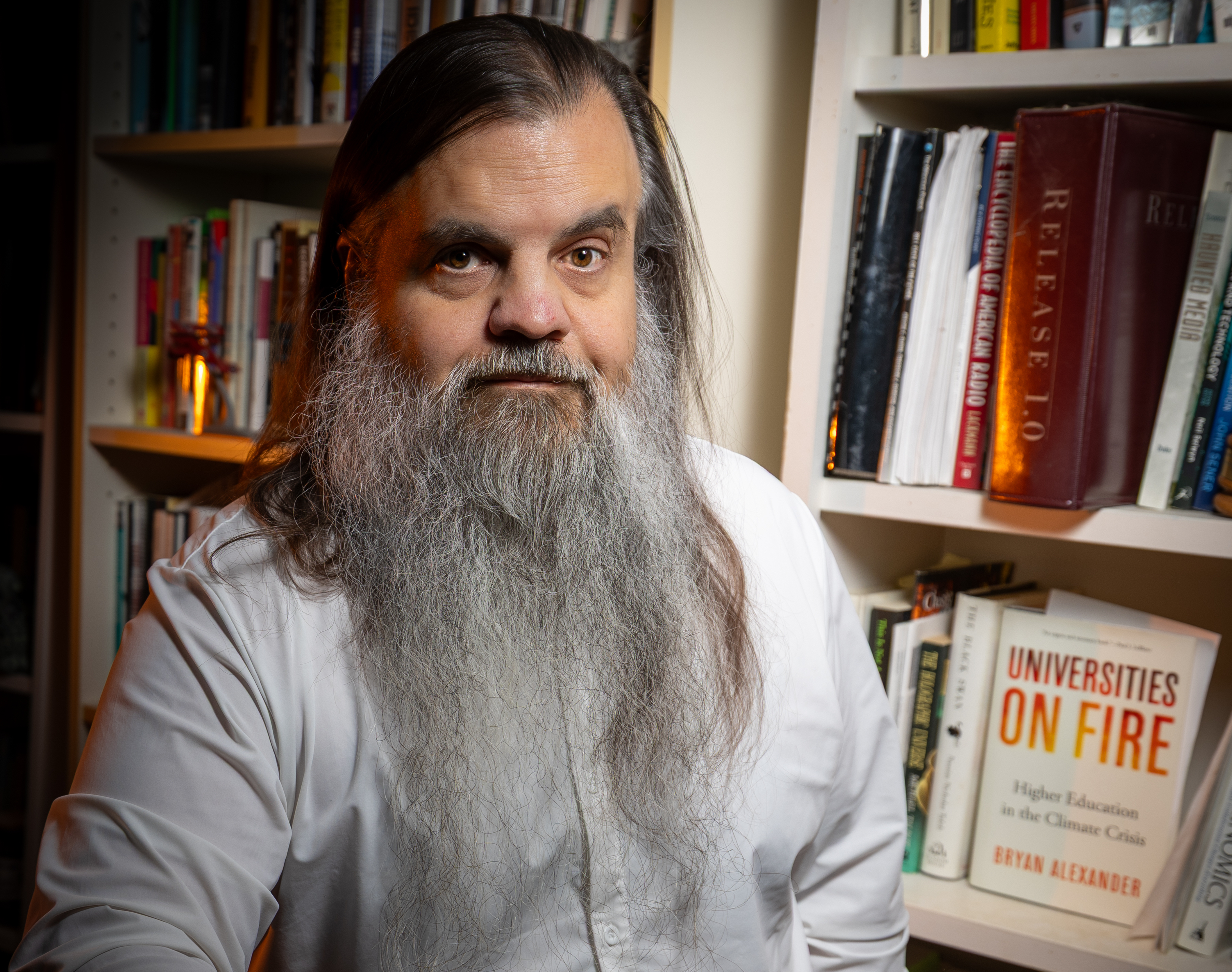
Bryan Alexander is a senior scholar at Georgetown University and a futurist who has tracked higher education's trend lines for two decades. His latest book is “Peak Higher Ed: How to Survive the Looming Academic Crisis.” His previous book, “Universities on Fire: Higher Education in the Climate Crisis,” won the 2024 Frederic W. Ness Book Award. He sat down with Kent State President Todd Diacon on the ToddCast for the conversation that runs through this series.
Futurist and Georgetown Senior Scholar Bryan Alexander tells Kent State President Todd Diacon that the “demographic cliff” behind the shrinking numbers of 18-year-olds is just one factor driving the changing face of higher ed.
Transcript
I kept coming back to this decline and wondered how it happened, what caused it and how might it continue. And so I brought in a whole series of forces which we can talk about, one of them being demographic change, another being changing attitudes in American culture toward higher education, changes in the labor market, some political transformations. And so what I ended up with is the sense that if we're lucky, we may have just survived a dip, a long dip, more than a decade, and we may return to a period of incremental growth. Or we might not.
The decline is multilayered — birth rates, migration, cost, culture — and it isn't reversing on any timeline a university can wait out. Institutions get a choice: shrink with the 18-year-old population or serve everyone else.
Starting Earlier. Finishing Stronger.
Among the opportunities for Kent State: Partner with Ohio high schools to better tailor College Credit Plus to empower students to begin courses in their majors. Then accelerate Kent State degree completion with ready options to continue the fast pace into grad programs.
2/3
of Kent State graduates stay in Ohio
$10
return on every state dollar invested
Kent State Is Well Equipped to Serve Learners at All Levels
81
academic certificates
40+
Ohio TechCred certificates, available for high schoolers to retirees
20
majors at the associate degree level
123
majors at the bachelor’s degree level
161
graduate degree programs
“The term polycrisis lets us wrap this up together.”
Futurist Bryan Alexander, author of "Peak Higher Ed: How to Survive the Looming Academic Crisis," shares with Kent State President Todd Diacon how he came to use the term "polycrisis" to describe the collective force driving transformation in higher education.
Transcript
I use this term because this helps us think about all these multiple overlapping forces. I mean, you're in Ohio, the demographic transition's proceeding very, very quickly. Your population is aging up, the number of children is shrinking. So that's happening throughout the Midwest as well as the Northeast, big chunks of the South, some of the high West. But we can also tie this into the arrival of generative AI and how that has some kinds of impacts on higher ed. To this we can add the geopolitical struggle between the United States and China and now the United States and Iran and how that has certain impacts on academia and so on. The term polycrisis lets us wrap this up together in, I think, a useful way.
Demographics, funding, public trust, technology — the forces overlap and amplify each other. That's why no single fix works, and why this series exists: Each installment is one front in the same story, and Kent State is answering on all of them.
What You Can Say
Ohio's demographics are changing. Kent State changed first, serving learners at all levels: eight campuses, college credit in high schools, programs for working adults, professional credentials, associate, bachelor's, three-year bachelor's and graduate degrees powered by the top public research university north of Columbus.
Fewer 18-year-olds doesn't mean Ohio needs less education. As the nation's best state for business, Ohio can't afford to waste a single talent. That's what Kent State is built to prevent.
Every Rung of the Ladder, One Graduate

From the Factory Floor to the IT Desk
Kayla Hodge was a custodian at a factory when she enrolled at Kent State University at Trumbull. An online associate degree came first, then an online bachelor's in information technology. Today, she is an IT analyst at Akron Children's Hospital, where Kent State alumni make up nearly 10% of the workforce. Her path ran through a regional campus and a screen, not a dorm — and that is the point. The Ohio that is coming needs more Kayla Hodges, and a university built to reach them.
Read More »Up Next:
AI is rewriting jobs, science and the news you read. In our next installment: why a complicated world is exactly when you want a university nearby, and what Kent State's researchers — its computer scientists, historians and humanists — are already doing about it.