

Allyson Tessin, Ph.D., assistant professor in Kent State University’s Department of Earth Sciences, has received a National Science Foundation (NSF) Faculty Early Career Development Program (CAREER) Award to support her research on how the seafloor and ocean interact in rapidly changing Arctic environments.
The five-year grant will allow Tessin and her research group to study how melting permafrost and warming waters in the Arctic are altering chemical exchanges between ocean mud and seawater. These processes influence the global climate, marine life and human resources, such as fisheries.
“CAREER grants are amazing opportunities,” Tessin said. “It’s exciting to further investigate this rapidly changing region and expose Kent State students to Arctic Oceanography.”
Researching the Rapidly Changing Arctic
Tessin, who specializes in geology and oceanography, said the Arctic is an ideal place to study these dynamics because it is warming faster than any other region on Earth. Her team has previously collected seafloor cores from the Gulf of Alaska aboard the National Science Foundation’s research vessel Sikuliaq, and the new project will extend that work farther north into the true Arctic.

Tessin’s team will study how melting permafrost soil collapses and moves into the ocean, a process that reshapes coastal ecosystems and affects the chemistry of Arctic waters. By taking long sediment cores, the researchers will also examine roughly 20,000 years of Earth’s history, dating back to the last Ice Age, to better understand how the environment has responded to past periods of rapid warming.
Her research combines modern observations with paleoceanography, the study of ancient oceans, to provide context for today’s rapid changes.
“That’s how my group tends to think about things — a set of modern observations coupled with paleoceanography,” Tessin said. “It’s a cool expansion of the work we’ve been doing in a different Arctic environment.”
The team uses a variety of coring methods, from half-meter multicores that collect live sea-floor ecosystems to larger piston cores that can reach depths of up to 80 feet of mud.
“We were bringing up sea stars, shrimp and sponges,” Tessin said. “You capture some of that little ecosystem in the tube.”
Connecting Science and Education
Beyond research, the NSF CAREER program emphasizes education, which is a component Tessin said she’s eager to expand.
“I’m proposing ways to take the classes I teach here at Kent State and integrate more connection between my research group and [those classes],” she said. “It gives these really neat opportunities to take these two separate parts of my job as a professor and meld them much more.”
Her Marine Processes course allows Kent State students to plan a simulated oceanographic cruise, choosing research sites and contingency plans just as professional scientists do.
Empowering Students Through Experience
Tessin’s students have already gained hands-on experience through seagoing expeditions. Doctoral Student Tatiana Fernandez Perez has sailed with Tessin twice in Alaska after serving on a Mediterranean research cruise through the International Ocean Discovery Program (IODP). Rachael Gray, a Ph.D. student, sailed on an IODP cruise to Baffin Bay (IODP 400) and the Gulf of Alaska once. Hailey Connor, a graduate student, sailed twice to the Gulf of Alaska. Thilini Wijewardhana, a Ph.D. student, sailed to the Gulf of Alaska once.
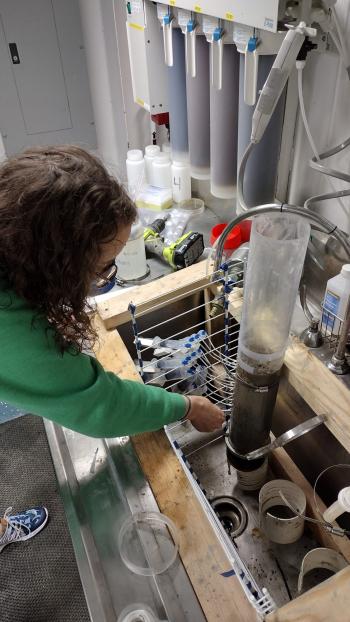
“These opportunities are excellent,” Tessin said. “You meet lots of people who facilitate science in different ways—It’s always really fun for the students to increase their network and confidence.”
The award will also strengthen Tessin’s collaboration with the Alaska Native Science and Engineering Program, which supports students from rural villages who are highly affected by changing climates and may not have access to science education.
“These areas are really important to them,” Tessin said. “Building those connections to make sure the people who are impacted the most is another key part of the project.”
Studying Oceans from the Midwest
Although based in Ohio, Tessin said Kent State is an ideal home for an oceanographer.
“Most oceanographers don’t work in their backyard,” she said. “What happens in the ocean impacts all of us.”
Tessin said the Great Lakes serve as an ideal training ground for students conducting fieldwork and learning research methods close to campus. She also said Kent State’s Department of Earth Sciences has provided strong support for her teaching and research efforts.
Tessin, who joined Kent State five years ago and will be applying for tenure this year, said she’s very grateful for the opportunity the NSF CAREER Award provides.
“For a long time, this has been my [five-to-10-year] goal,” she said. “We have five great years of science to do.”
###
Top photo caption: (L to R) Rachael Gray, Allyson Tessin, Tim Gallagher, Hailey Connor, Kyle Smart, Tatiana Fernandez Perez, Chelsea Smith (all of Kent State at the time) on board the RV Sikuliaq in coastal Southeast Alaska.
Media Contact:
Jim Maxwell, JMAXWEL2@kent.edu, 330-672-8028