
When You Get That Call
It's 10:30 on a weeknight. Will Kalkhoff, Ph.D., a professor and graduate program coordinator in Kent State's Department of Sociology and Criminology, has just settled in after a long day. Then his phone goes off.
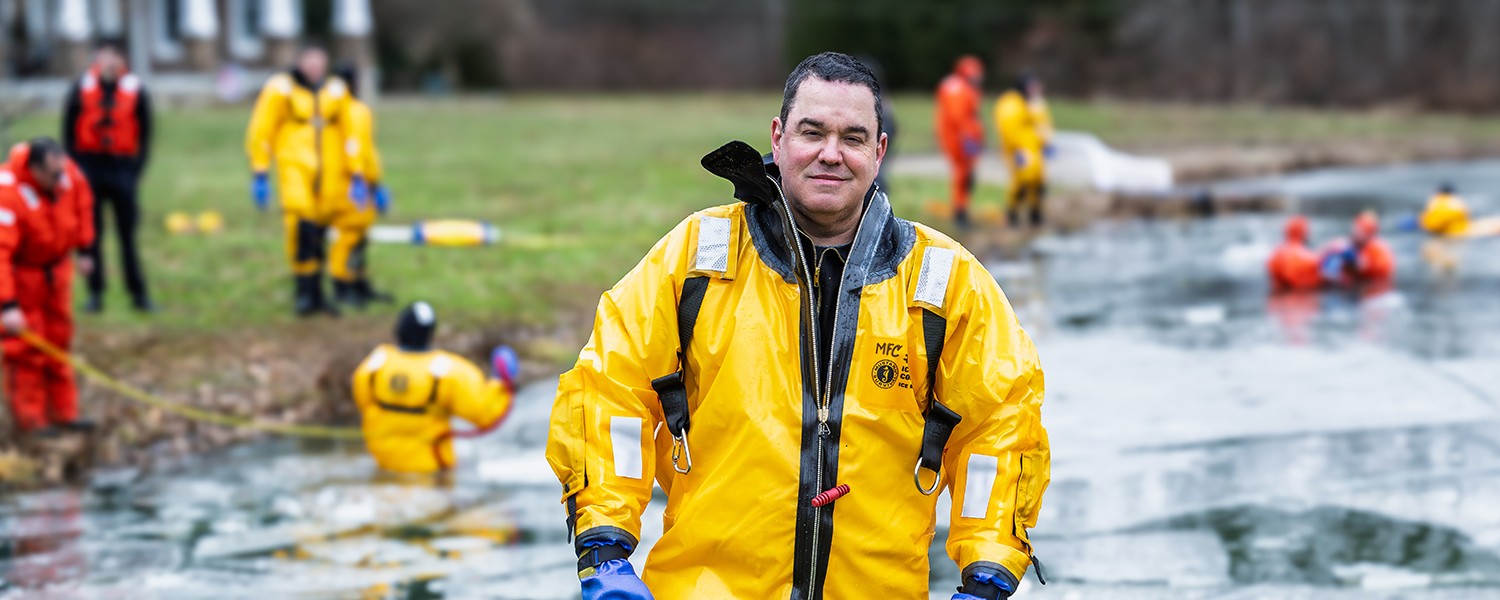
A possible drowning. A local lake. The clock starts ticking.
Within minutes, he's on his way. And in that moment, everything he teaches in the classroom becomes something else entirely.
"You can read about emergency management and multi-agency teamwork," Kalkhoff said. "But until your phone goes off, and the clock starts ticking, and it's 10:30 at night and you're on your way to a lake in the middle of the night to try to find a person who's gone missing under the water, you have no idea what that feels like."
"I remember feeling my mouth go dry, feeling my heart beating in my chest and thinking, 'I've got to get there. I've got to get there now,'" Kalkhoff said. "You've got individuals from all these different agencies including fire departments, sheriff's offices, police departments who are converging from all over the county to try to save the life of somebody they've never met. In my lifetime, that might have been the greatest sense of urgency I've ever experienced."
For Kent State students, learning from someone like Kalkhoff isn't just an educational advantage. It's a window into what their future careers could actually look and feel like.
A Professor Who Does More Than Profess
By day, Kalkhoff is a professor teaching courses on criminal justice, researching police officer performance and mentoring students on their path to careers in sociology, law enforcement and public safety. On weekends and evenings, he's a reserve sergeant with the Stow Police Department, working side-by-side with commissioned officers, designing training scenarios and helping shape the next generation of law enforcement professionals. And at any hour – day or night – he might get the call to respond as a member of the Portage County Water Rescue Team, where he puts his scuba divemaster certification to work alongside first responders from fire and law enforcement agencies across the region.
Kalkhoff has spent nearly 25 years teaching at Kent State, where his research and teaching interests span social psychology, group dynamics and criminology. He also founded the Electrophysiological Neuroscience Laboratory of Kent (ENLoK), built on the idea of combining sociology with neuroscience to test emerging ideas about how people behave, perform and make decisions under pressure – research that would, in ways he didn't anticipate, lead him far outside the classroom.
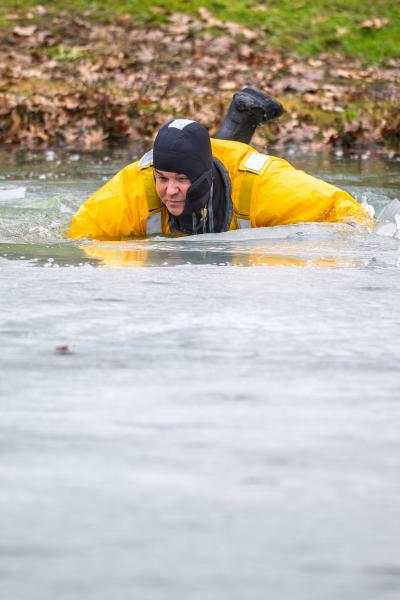
In recent years, Kalkhoff has extended his work well beyond Merrill Hall where he teaches. He is a training sergeant with the Stow Police Department Reserve Unit and a member of the Portage County Water Rescue Team, where he works alongside firefighters and law enforcement officers from across the region on everything from shore support and sonar operations to ice rescue training and live emergency dispatches. He is currently working towards earning his Dive Rescue 1 certification.
A Winding Road to Service
Kalkhoff's path to service didn't begin in a squad car. It began over coffee.
A few years ago, he sat down with Lt. Mike Lewis of the Kent Police Department (PD). Kalkhoff had recently created the ENLoK and Kent PD was in the process of equipping its officers with body cameras. The two decided to collaborate on applied research, studying how camera monitoring might affect police officer performance in high-stress, critical incident situations.
That research partnership led to work with the Ohio Peace Officer Training Academy and eventually with MILO, an international law enforcement and military training company. Kalkhoff found himself spending significant time with police administrators, officers and training professionals.
"By working so closely with law enforcement administrators and police officers as well as training professionals, I came to see things from their perspective," Kalkhoff said. "I gained a scientific and personal understanding of the complex challenges that police departments and police officers face today, and I became gripped by a drive to serve however I could."
What struck him most was something harder to quantify than data. "Almost universally, the police officers and trainers I worked with had this incredible commitment to serving the community," he said. "Spend enough time around those kinds of people, and you'll catch the fever."
Turning 50 sharpened that feeling into urgency. He recalled a line from the poem "Success" by Bessie Anderson Stanley that had hung on his family's wall since childhood that states, "He has achieved success...who has left the world better than he found it."
"I found myself thinking, 'What more can I do in the time I have left?'" Kalkhoff said.
When he saw an advertisement for the Stow Police Department Reserve Unit, he didn't hesitate. When the opportunity arose to join the Portage County Water Rescue Team, he jumped at that too.
The decision was also shaped by the weight of the times.
"Political polarization and unrest had reached new heights, and then on top of that we had to deal with the COVID pandemic," Kalkhoff said. "In overwhelming circumstances where it feels like the world is coming apart, there's always the temptation to bury your head in the sand and hope it all just goes away. Life's challenges have taught me that action is the best antidote to despair. If the world feels heavy, go out and do something, physically and tangibly, to make it better. No effort is too small."
What the Professor and Reserve Sergeant Brings to the Station
As training sergeant, Kalkhoff draws directly on nearly three decades of classroom experience. When he joined the Reserve Unit, preparation for new recruits consisted largely of sitting around a table and reading the standard operating procedures manual.
"The new reservists weren't really getting any classroom training in how to be a reserve officer before they went into field training," Kalkhoff said.
Working alongside Reserve Commander Captain Greg Hunter and Reserve Coordinator Sgt. Kasey Olesinski, Kalkhoff developed a full curriculum, which is scenario-based, instructor-led and grounded in the same pedagogical principles he uses in his Kent State courses.
Ask Sgt. Olesinski what Kalkhoff contributes to the Reserve Unit, and she doesn't hesitate.
"He's really taken on more responsibility as a sergeant," Olesinski said. "He communicates with new applicants, helps with recruiting, assists with interviews, and his background working with students and people really helps him have a viewpoint of whether he thinks they'll work out for us."

What strikes Olesinski most is how Kalkhoff's academic and technical skills translate directly into police work. He's helped develop training curriculum, streamlined the department's backend systems, and brought a level of instructional precision the unit didn't have before.
"He's very good at streamlining the training plans," Olesinski said. "We don't have that kind of background to put together that kind of class. So, he's been really helpful."
His role in scenario-based training is where the exchange between professor and reserve officer becomes most vivid. Kalkhoff doesn't just design the scenarios, he acts in them, playing individuals in mental health crises, people who've committed offenses and uncooperative subjects. He brings props: a rocks glass filled with apple juice standing in for bourbon or fake blood spatters to provide visual realism. Details like these, brought together with stressful scenarios, recreate the sensory overload that helps officers learn to process the messy complexities that enter into split-second judgement.
"He kind of plays all those different ends of the spectrum," Olesinski said. "He gets to see how the same officers handle different scenarios, and he changes his behavior based on how they respond, and they respond based on how he changes his behavior. It's a give and take."
For Olesinski, that loop runs in both directions. "I think it really gives him a better understanding of what his students will actually face in real life," she said.
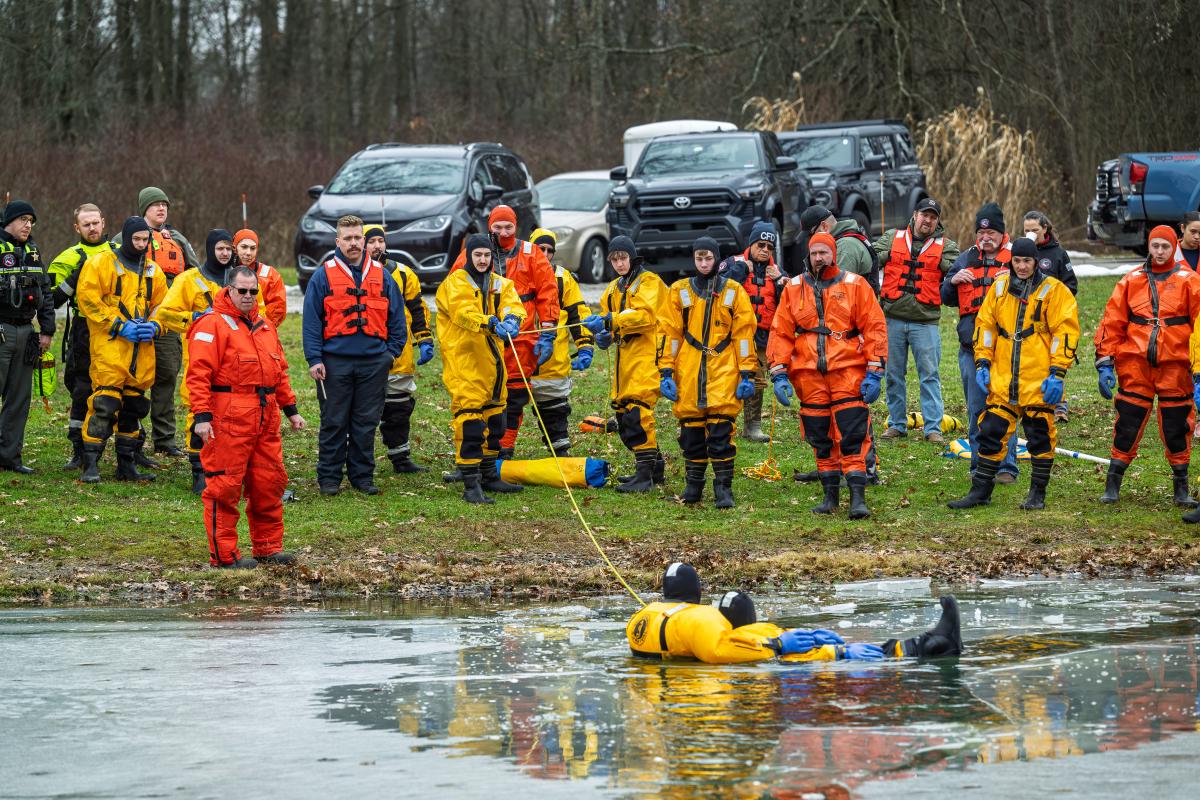
On the Water Rescue Team, the same commitment shows up differently in monthly trainings covering shore support, sonar systems, drone operation, ice rescue and dive rescue techniques.
"It's a perishable skill," Kalkhoff said. "If you're not doing it, you're going to forget it."
From the Field Back to the Classroom
Kalkhoff uses everything he experiences in the field to enrich what his Kent State students learn. The most powerful example, he says, involves use-of-force policy.
"When I first joined the Reserve Unit, we had to learn the department's use-of-force policy. This policy and related policies take up a significant chunk of the entire policy manual, which is over 800 pages," Kalkhoff said. "I think most people have no idea how long and detailed these policy manuals are."

That knowledge transforms how he teaches.
"You can teach students relevant case law from a textbook, but it's a lot more meaningful when you can discuss how that case law is reflected in different standard operating procedures that some departments make available online,” Kalkhoff said. “By pairing Supreme Court precedents with the specific policies used by real police departments, students gain a ground-level understanding of use-of-force that transcends the textbook. This empowers them to evaluate use-of-force incidents with fairness and precision. But it's very hard to tell someone what it's actually like to be a police officer — the length of the shifts, the kinds of decisions they're making, the rewards and the toll it takes."
On average, he tells his students, police officers experience four to five traumatic events a year.
"The average person may experience that many in a lifetime," Kalkhoff said.
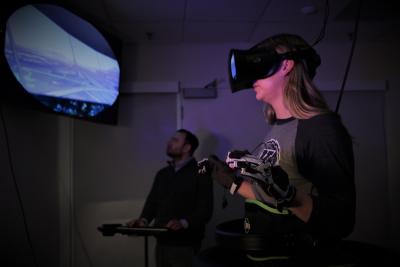
He's also brought a screen-based simulator system into the classroom, giving students direct experience with realistic scenarios that police officers encounter regularly.
"Having hands-on experience helps you explain content from a vantage point that college professors don't always have," Kalkhoff said.
"When you can bring that material to life with stories from real-world experience everybody perks up,” Kalkhoff said. “Students walk away with a richer understanding of the topics you're covering in class."
There's a concept Kalkhoff returns to when helping students understand what multi-agency emergency response actually feels like: "flow." It's the sensation of being fully in the zone, when skills, trust, and communication come together so seamlessly that individual effort disappears into collective purpose.
"When lives are on the line and minutes or even seconds count, members' skills, their unspoken trust for one another, their lack of ego and their ability to communicate with something as subtle as a glance are the things that come together to optimize outcomes," Kalkhoff said. "The water rescue team trains often. And while we don't say out loud that we train in order to achieve team flow when it counts, that is, in large part, exactly what's going on."
A Lesson for Students
Kalkhoff's story carries a direct message for students considering careers in criminal justice, law enforcement or public safety: don't wait for your career to give you experience. Go get it now.
"Get involved," Kalkhoff said. "At the very least, contact your local police department or sheriff's office and ask about doing a ride-along. For those seriously considering a career in law enforcement but are on the fence, apply to become a reserve officer or an auxiliary officer. The things you regret in life are not the things that you did. They're the things you didn't do. And you will get to a point in your life where it is too late to be a police officer.”
He points to a pair of former students as proof of what's possible. Martin and Miles Ashbaugh, identical twins who graduated from Kent State in 2025, each took a different path through Kalkhoff's world. Martin enrolled in Kalkhoff's class to become a Reserve Officer. Miles became Kalkhoff's first trainee when he was designated a Field Training Officer. Today, Martin is a police officer with the Richfield Police Department. Miles is a deputy with the Summit County Sheriff's Office.
"Martin and Miles are among the finest, most upstanding Kent State students and people I've ever met," Kalkhoff said. “And they are on their way to becoming model law enforcement professionals. Both Martin and Miles credit their success to their experiences at Kent State, at the Kent State Police Academy and at Stow PD."
But the impact, he’s quick to point out, ran both ways.
"They helped me see that at its best, teaching is really a mutual process where you learn for, from and with your students and trainees," Kalkhoff said.
The Spirit of Service
Across all three of his roles (researcher, reserve sergeant, water rescue team member) the thread connecting everything for Kalkhoff is a simple but powerful belief.
"Struggle and suffering can't be eliminated from the world, but there's something to be said for trying," Kalkhoff said. "You never know what greater good might result from a seemingly trivial act of assistance. A typical vehicle lockout call lasts only a couple of minutes. But by responding promptly and getting the person on their way, maybe they make it to a job interview they otherwise would have missed. A small act of service can ripple outward in ways you may never foresee or fully comprehend."
There's a motto on the Portage County Water Rescue Team that Kalkhoff tries to carry with him into the professional spaces he occupies: No egos. After every operation, the same question is asked: "What could we have done better?"
For Kent State students beginning to imagine careers in criminal justice and public safety, that question, asked honestly, asked often, might be the most important lesson of all.
# # #
Media Contact:
Jim Maxwell, JMAXWEL2@kent.edu, 330-672-8028