
When Kendric Hood started his Ph.D. at Kent State, he was already one of the Computer Science Department's own -- he had earned both his undergraduate and master's degrees there. Now a third-year doctoral student, adjunct instructor, and researcher with a job offer in hand from one of the country's most prestigious national laboratories, Hood's trajectory offers a compelling picture of what a graduate education in computer science at Kent State can lead to.

His research spans two distinct but philosophically connected areas: neuromorphic AI, which draws inspiration from the biology of the human brain, and transformer-based machine learning applied to real-world systems. In both, Hood is doing something he says defines his approach — taking concepts that are well-documented in theory and finding out where they actually work in practice.
Listening to Machines and Bodies
One strand of Hood's work involves non-intrusive load monitoring for manufacturing. The idea is straightforward in concept: record how much electrical power a welding machine is drawing from the wall, feed that data through a machine learning model, and make inferences about whether the weld being produced is good or defective — all without stopping or altering the process. It's less wasteful and less disruptive than pulling finished products apart for manual inspection, and Los Alamos National Laboratory has been sufficiently impressed that they've offered Hood a full-time position upon graduation.
His newest research direction ventures into health informatics and voice biomarkers. Physicians already use voice exercises — coughing, reading passages, sustaining a tone — to help diagnose conditions like Parkinson's disease and depression. The catch is that it requires a specialist in the room, can be hard to do remotely, and is prone to variability across examiners.
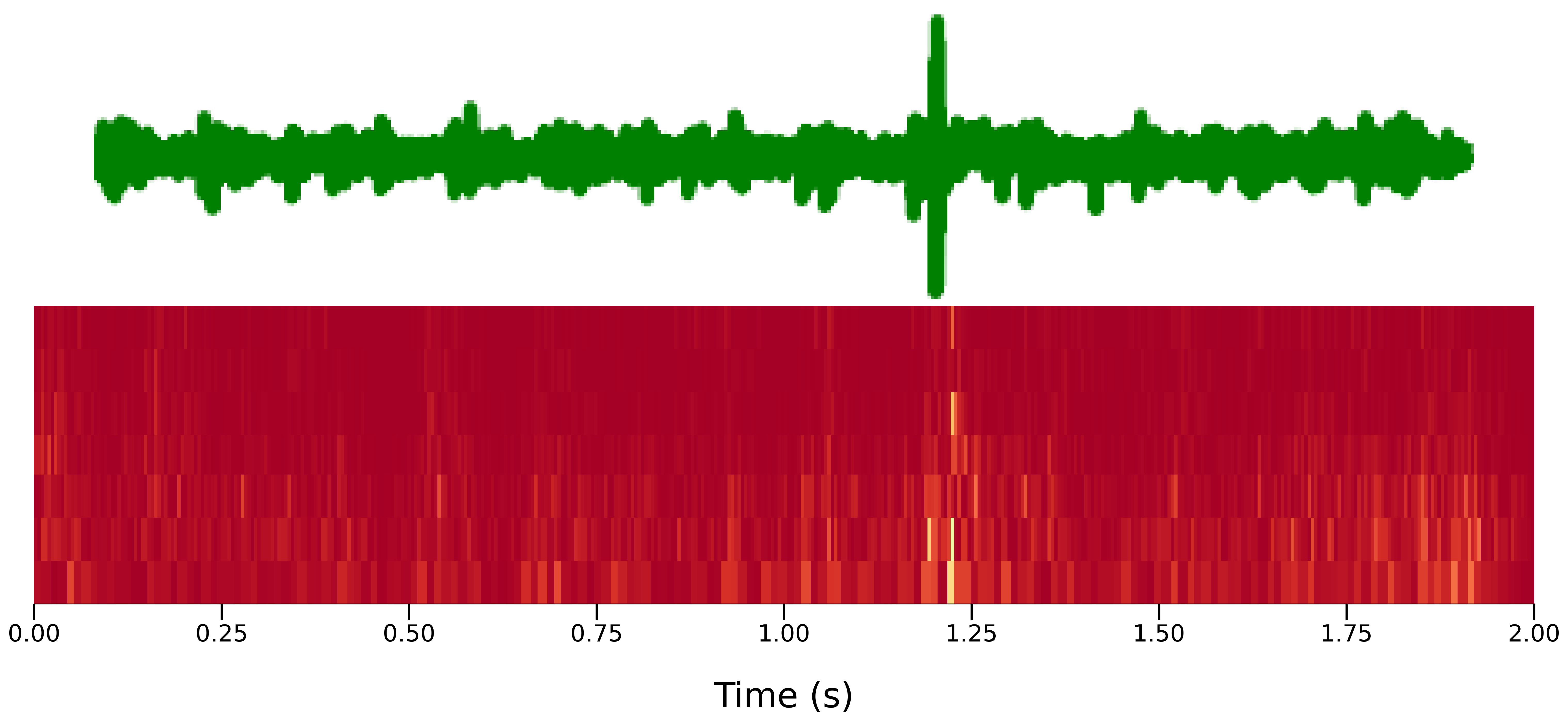
Hood is applying neuromorphic AI to recordings of those same exercises, building a model that can analyze audio spectrograms and flag signs of multiple diseases at once. The goal is a framework accessible enough that a patient could record themselves at home and send the file in — no specialist required.
"Our model is showing decent results across a variety of diseases," Hood said. "That's the first time I've seen that. The idea is that if there are new diseases we can get enough data on, the framework should be able to handle those too."
The Kent State Advantage
Hood is quick to credit the department's faculty as a defining feature of his experience — and not just in the classroom.
"What drove me to Kent were the advisors. They're very well connected for how quiet and humble they are. I got my job at Los Alamos through a recommendation from my advisor. When I was an undergrad, I got a position at IBM the same way." - Kendric Hood, Computer Science Ph.D. student
He also points to the variety of mentorship styles available in the department as an underappreciated strength. Some faculty take a hands-on approach, working closely with students through each stage of their research. Others give more independence. For Hood, being able to find an advisor whose style matched his own made a real difference.
Advice for Students Considering Graduate School
Hood doesn't sugarcoat the job market, but he offers a clear-eyed perspective. Getting that first position after graduation is the hardest part, and it may take time. But once students establish themselves, the demand for experienced computer science professionals remains strong — and a graduate degree provides the depth to sustain a long career.
"Anyone who comes through this program and gets their first position is going to be pretty set," he said. "They're not going to have a hard time finding work at any point in the future."
For Hood, graduation and a move to New Mexico are on the near horizon. The research that started in Kent State's labs is heading to one of the world's foremost scientific institutions — and it all started here.
LA-UR-26-22585