Undergraduate Awards & Scholarships Made Possible by Donations to the Department
Each year, the Department of Psychological Sciences gives awards for Outstanding Seniors, Outstanding Juniors, and one College of Sciences and Humanities Leadership Award. Award-winning undergraduates are identified for their excellence by faculty.
We also award several “Dr. F Robert and Nancy Treichler Awards” scholarships each year. These go to psychology majors in need of additional financial support.
Our awards and scholarships are only possible with generous donations to the Department of Psychological Sciences from Alumni, Retired Faculty, and Friends. We would like to extend our heartfelt gratitude for your gifts!
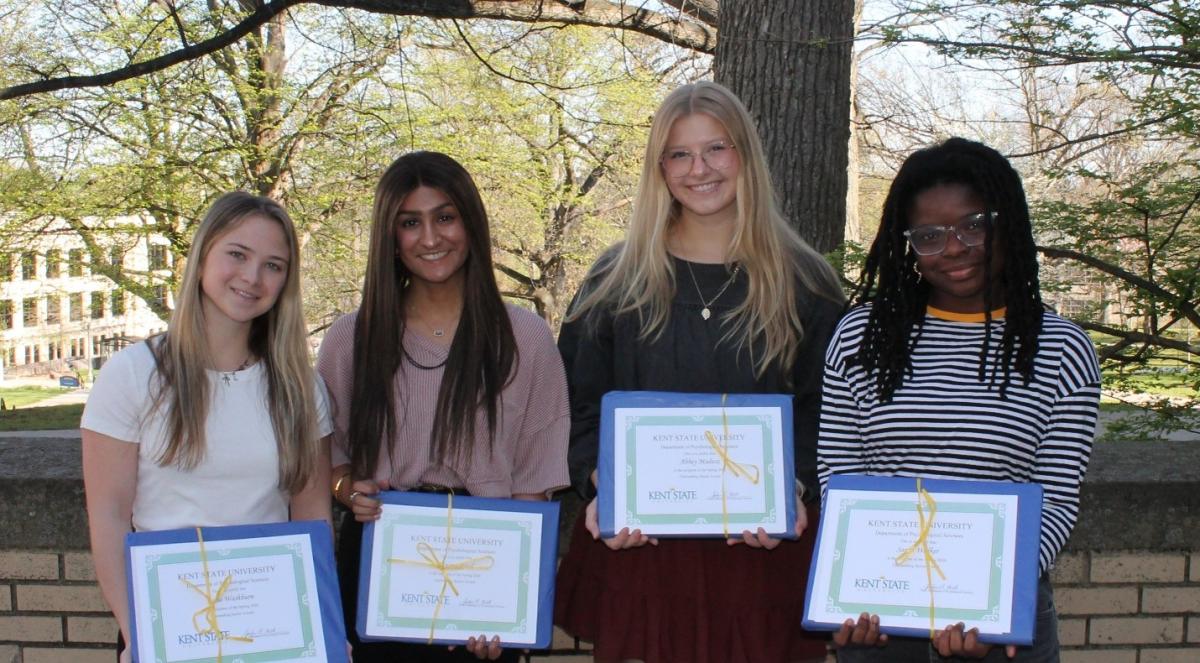
Outstanding Senior Awards
Abbey Madasz (Nominated by Dr. Kathleen Casto)
Abbey has worked for Dr. Casto for two years working her way up from research assistant to SURE fellow to lab manager. Abbey is above level relative to her peers in her sense of responsibility, professionalism, and ability to undertake research projects. She has shown a high academic aptitude. She is a registered behavior tech, a university tutor, the social chair for Psi Chi and is a RBT classroom coordinator at an Autism Center in addition to many other volunteer roles.
Vinaya Patel (Nominated by Dr. Chris Was)
Vinaya worked with Dr. Was in the SURE program. She designed and executed a study on mind wandering that was award winning and has been published in Cognitive Science Research. Vinaya is the first author on this publication. Vinaya works as a tutor at the Academic success center and is a patient care assistant at Akron Children’s. She holds numerous leadership positions across campus and is actively involved in volunteering.
Sarah Walker (Nominated by Dr. Angela Neal-Barnett)
Sarah will attend John Carroll for graduate school in Mental Health counseling beginning in Fall 2026. She testified before a congressional committee on Black women and girls, and she is ABA certified. She also participated in SURE and is a member of both the PRADA lab with Dr. Neal Barnett and the Social-Health Risk Perception Lab with Dr. Taber
Lillie Washburn (Nominated by Dr. Judith Gere)
Lillie's academic performance shows that she is motivated and conscientious. She earns high grades across her classes, for example, Lillie was the top-performing student in her Research Writing class. In this class, Lillie received over a 99% in the course and was the only student who scored that high. In addition to her work in research she is shelter advocate at Forbes house and is a regular recipient of the scholar-athlete award. She is certified in ABT.
College of Sciences and Humanities Leadership Award, Psychological Sciences
Abbey Madasz (Nominated by the Undergraduate Psychology Committee)
Abbey’s work in Dr. Casto’s lab for the past two years demonstrates that she is a rising star. Her peer interactions, level of responsibility and professionalism, and independence in undertaking lab tasks and research projects truly set her apart. We are thrilled that Abbey was bestowed this honor from the College!
Outstanding Junior Award
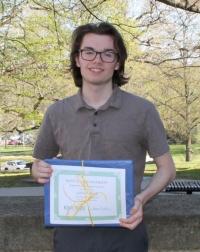
Gabriel Powlison (Nominated by Dr. Sarah Black)
Gabriel is a wonderful member Dr. Black’s lab team! He began planning his senior honors thesis a full year early. He is highly organized, ambitious, and very committed to a career in psychological sciences. He is a member of the Peer to Peer mentor support program as well as Psi Chi. Congratulations, Gabriel!
Dr. F Robert and Nancy Treichler Scholarships
Jude Spies
Jude is a member of the Himmelstein SWAG lab and was an outstanding research assistant. He also works at the university library.
MinJee Howell
MinJee began college earlier with the BRIDGES program. She has participated in the SURE program three times and she was a student research mentor last summer.
Ava Middaugh
Ava is a first-gen student and balances a full-time work-load in addition to her academics. Despite holding two full time positions, Ava has a 4.0 GPA.
Adeline Albert
Addie is a brain injury survivor and luge athlete. She is a double major in neuroscience and psychology and wants to pursue traumatic brain injury research in athletes.
Emiliee Mikovich
Emiliee works to help support her four younger siblings as well as 3 nieces and nephews. She does this while helping out in her community and juggling a full time course load with a high GPA.
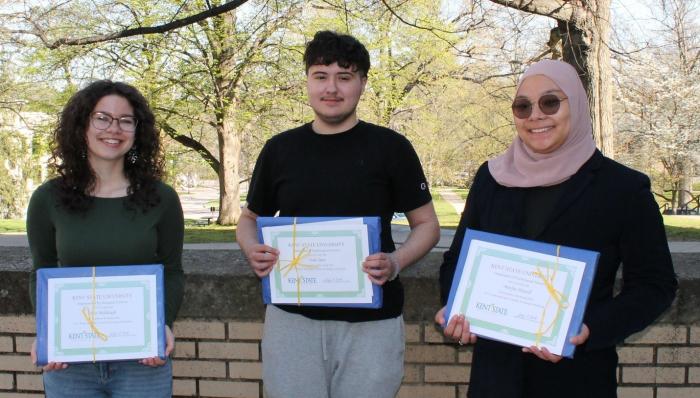
*Not pictured: Emiliee Mikovich and Addie Albert
Undergraduate Authors of Published Peer-Reviewed Research
A total of six of our undergraduate majors published peer-reviewed research manuscripts with Kent State faculty in psychological science during the last academic year.
*Denotes undergraduate author
Vinaya Patel published the following paper with Dr. Chris Was on implicit learning:
*Patel, V., & Was, C. A. (2025). Is it Possible to Learn Complex Implicit Tasks, Such as Artificial Grammars, While Mind Wandering?. Cognitive Science Research. doi 10.22059/jcsr.2025.400958.1018
Abigail Vild & Maggie Wilson published the following paper with Dr. Chris Was examining the relationship between student satisfaction and test scores.
*Vild, A. R., *Wilson, M. E., & Was, C. A. (2025). Students' Test Satisfaction Goals Are Well Calibrated to Their Test Scores. Journal of Research in Education, 33(1), 63-79. https://eric.ed.gov/?id=EJ1469313
Cameron Wittschen published the following paper with Dr. Chris Was on mind wandering while multitasking.
Wittschen, C. G., & Was, C. A. (2025). Influence of Mind Wandering and Increased Attentional Demands on Multitasking and Implicit Learning. Europe's Journal of Psychology, 21(1), 65. doi 10.5964/ejop.14605
Andrew Bowser was included as an author on Dr. Kathleen Casto’s paper on hormones and cortical activation during competition.
Casto, K. V., Cohen, D. J., Hicks, C., & *Bowser, A. (2026). Testosterone, cortisol, and fNIRS‐based cortical activation associated with competitive task persistence and difficulty. Journal of Neuroendocrinology, 38(4), e70185. Doi 10.1111/jne.70185
Hannah Fender published the following meta-analysis with Dr. Phillip Hamrick on mentor and language.
*Fender, H., McClure, K. L., & Hamrick, P. (2026). Episodic memory and language in early childhood: A meta-analysis of studies using deferred imitation. Journal of Cognition and Development, 1-17. Doi /10.1080/15248372.2026.2632278
Kay Budrovic published a paper with Dr. John Gunstad and Dr. Phillip Hamrick on language in Alzheimer’s.
*Budrovic, K., Gunstad, J., & Hamrick, P. (2026). Formulaic and novel language dissociate in Alzheimer’s clinical syndrome: evidence for the Dual-Process Model. Journal of Clinical and Experimental Neuropsychology, 48(5), 473-483. doi 10.1080/13803395.2026.2674224
Summer Undergraduate Research Experiences & Brain Health Research Fellows
The department of psychological sciences had 15 majors participate in two different types of competitive, paid research fellowships during the Summer of 2026. We selected three students to share their experiences:

Krysa Dickson (mentor: Mary Himmelstein)
“Over the summer I participated in the Summer Undergraduate Research Experience (SURE), which gave me several opportunities that helped me prepare for a PhD program in Social Psychology. Over the last two months I gained greater experience in using syntax-based statistical software to clean and analyze quantitative data for my honors thesis, which focuses on resilience. I applied what I learned in quantitative methods to my own data to determine significant relationships among variables as well as the effect size for these relationships. I also spent a great deal of time learning to use thematic analysis for qualitative data. This involved working with my research team to develop a codebook, code qualitative data, and identify common themes. The SURE program allowed me time to work on my first, first-author manuscript for publication, which I expect to submit in the next few weeks. I learned how to develop my pre-registration into a research article. This involved learning how to write an in-depth review of the primary literature on my topic, how to describe my research methodology, how to report results of my data analyses, and how to write a discussion section. The SURE program has given me valuable experience I seek to utilize in the future as I pursue graduate school.”
Dominic Chifulini (mentor: Karin Coifman)
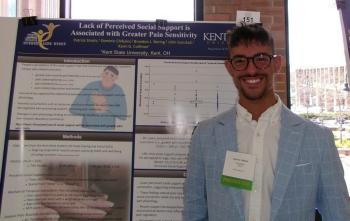
“When I found out about the SURE program, I immediately knew it was a fantastic opportunity for me. I also knew that I would want to do my project with Dr. Karin Coifman. In November of 2025, I proposed to her the idea of working together on a project. Dr. Coifman asked me to provide her with some different research questions I would be interested in solving. After looking at my ideas, we decided to explore the relationship between screen use, loneliness, and psychological symptoms. With these ideas locked in, one of Dr. Coifman’s graduate students, Brittany Baugher, joined in on the project.
I have been working as an undergraduate research assistant for Dr. Coifman since the Spring of 2025, working in the Clinical Affective Science Lab and the Student Life Study Lab. This summer, through the SURE program, I spent 40 hours a week in the SLS lab. I met weekly with my mentor(s) to analyze data collected and explore how it supports my research questions. I completed a poster on my research, which was the most exciting part of the program for me! As well as the 3-Minute Thesis presentation in the Fall. Being able to take all of my hard work and put it into a beautiful visual has really made the experience full circle for me. I look forward to having more opportunities to present my work.”
William Doering (mentor: Karin Coifman)
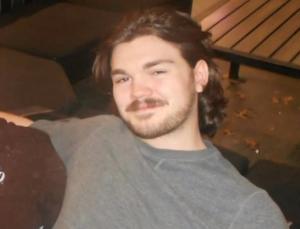
“My project as a Brain Health Research Fellow was my first experience running my own study. I looked at the gap between how people reported their emotional experience and what their face actually showed. Working on this project allowed me to build a stronger relationship with my mentor, Dr. Coifman, who helped me improve my understanding of the skills needed to produce and communicate a good study, such as attention to detail and the thoroughness needed to display and translate findings. Having the opportunity to present my poster gave me practice with public speaking and confidence in presenting things that I did not have before, especially when it came to something that was my own. Overall, this experience gave me a sense of what the process and day-to-day work of research involved and gave me more confidence in my goals and a clearer idea on how to achieve them.”