
College of Arts and Sciences
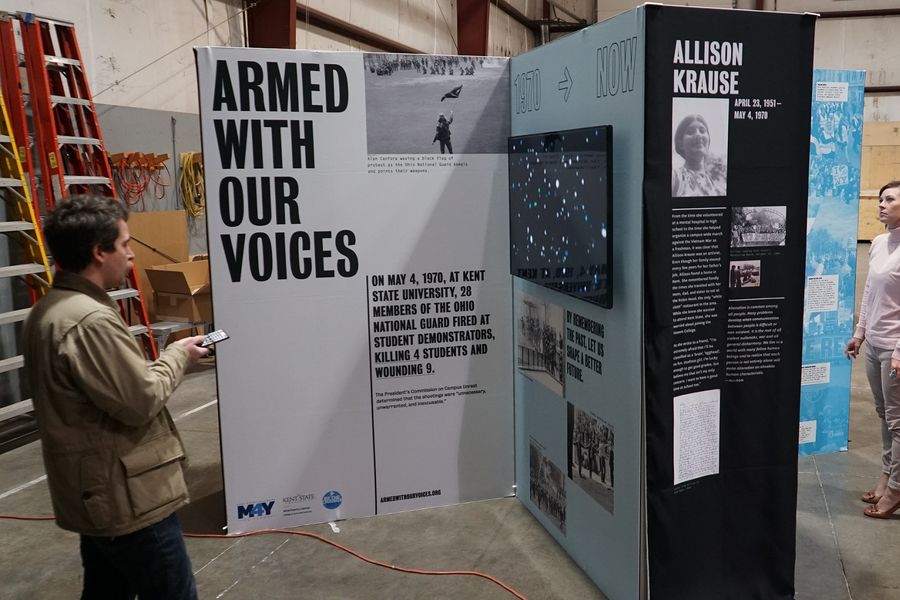
Kent State’s Wick Poetry Center to Debut National Interactive Exhibit in Support of 50th Commemoration of May 4
Kent State University’s Wick Poetry Center is set to debut its “Armed With Our Voices” exhibit this week in Austin, Texas, as part of the National Council for the Social Studies annual conference. The exhibit provides a powerful form of cross-generational connection that engages users in the events of May 4, 1970, and the importance of peace, conflict resolution and student activism today.

Collaborative Kent State Team Receives $1.5 Million Grant to Develop and Implement Drug Prevention Infrastructure in Three Ohio Counties
Kent State University’s College of Public Health is teaming up with the Department of Computer Science to develop and implement drug prevention infrastructure in Portage, Geauga and Lake counties.

Kent State Researcher and Professor Elected to the European Academy of Sciences
One of Kent State University’s most prolific and renowned researchers has been elected to the European Academy of Sciences. Quan Li, Ph.D., Senior Research Fellow in the Advanced Materials and Liquid Crystal Institute, joins the prestigious Brussels-based organization that includes about 660 member…Interdisciplinary Student Team To Travel to International Competition in Brazil
Thirteen cross-disciplinary teams presented in the Kent State competition for Mission:Life on Wednesday, October 2, 2019. The winning team, Virtual Harmony, will be presenting their concept in the international competition at the PUCPR University in Brazil on November 11. Virtual Harmony is a novel …
NIH Continues Support of Kent State Alzheimer’s Researcher With New Two-Year Grant
Once it begins, Alzheimer’s disease progresses systematically and aggressively, attacking victims on multiple fronts. But scientists studying the disease operate the same way – like Kent State University’s own Gemma Casadesus Smith, Ph.D.
Celebrating Our Own & Open Mic
The Wick Poetry Center held the Celebrating Our Own Poetry Reading and Open Mic on Thursday, Oct. 3. The reading started at 7:30 p.m. in the Wick Poetry Corner on the 2nd floor of Kent State’s University Library. The event was held to celebrate the 2019 Undergraduate Poetry Scholarship winners, who…
Sonia Sanchez Talks Poetry with Wick Students
The Wick Poetry Center welcomed poet, playwright and activist Sonia Sanchez to the May Prentice House for a meet and greet with students on Sept. 18. She met with them in the afternoon before giving a lecture in the Kiva in the evening. The Kent State Honors College, the Cleveland Foundation an…
Celebrating Tommy Freeman's Life
The Wick Poetry Center kicked off its 2019-20 event series year on September 13 with a celebration of Tommy Freeman’s life. The event was held in Room 120 of the Center for Architecture and Environmental Design with a reception afterward that expanded into the Wick Poetry Center’s Poetry Park. The e…
Model Kent State Language Academy Continues With 12th Year of Federal Funding
While the daily news is full of tumultuous conversations about Russia and China, Kent State University has been helping some area high school students learn to converse in Russian and Chinese to facilitate greater global understanding and a less contentious tomorrow.
