

Understanding Business Intelligence vs. Business Analytics
Business intelligence focuses on examining historical and current data to understand the present state of a business, while business analytics uses data and quantitative tools to predict future states and optimize decision-making.
Information is more readily available than ever. Where past business decisions were often based on societal trends or whatever information happened to be on hand, today’s data readiness has transformed the decision-making process. The essential skill now is understanding data and making sound decisions based on it.
Business intelligence and business analytics illustrate this process in the current environment. While these two methodologies were once treated as separate entities, their definitions are evolving to match present-day business needs. One useful way to frame the relationship is the Data Literacy Continuum, which draws a line across four connected concepts:
- Descriptive intelligence
- Diagnostic intelligence
- Predictive analytics
- Prescriptive analytics
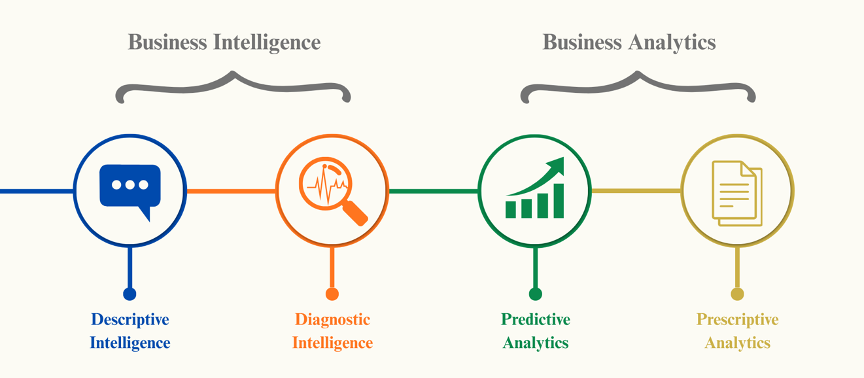
The following sections examine the difference between these concepts – both their similarities and their distinctions – to help determine which is the right fit for you and your future.
What Is Business Intelligence?
Business intelligence, or BI, is concerned with using data to understand the current state of a business and the reasons behind it. Organizations apply business intelligence by collecting, integrating, and surfacing both past and present data. This data can relate to any number of business areas, such as:
- Sales improvement
- Streamlining workflow
- Strategic output
- Finance optimization
- Market research
- Information technology (IT)
The information can then be compiled into detailed reports that illustrate the strengths of a business unit and highlight areas for improvement.
At its core, business intelligence examines historical and current data to show where a company stands in the present moment, letting analysts see which tactics should continue and which should be revised. Tools used by business intelligence analysts include reporting software, business activity monitoring software, and data mining tools.
Business intelligence is about insight into what is currently happening. Within the Data Literacy Continuum, it has two subsets: descriptive intelligence and diagnostic intelligence.
Descriptive Intelligence
Consider the question: “What has happened?” Analysts look at the current state of the business and summarize past and present data into an easily understood snapshot. This establishes a factual baseline and creates a foundation for sound decision-making.
Diagnostic Intelligence
The second piece of business intelligence asks: “Why did it happen?” This is where investigation begins – comparing information, separating variables, and more. Professionals take the description of what happened and drill down to the underlying reason.
What Is Business Analytics?
Business analytics, or BA, also uses data, but it predicts future states and informs decisions about business operations. Analysts take the output of business intelligence and begin the analysis pathway, focusing on where a company and its operations are headed. Businesses draw on current data and quantitative tools to do so. This work aims to improve elements such as:
- Customer relationships
- Market share opportunities
- Organizational structures
The true focus of business analytics remains its predictive efforts, such as data mining, machine learning, and modeling. These methods support tasks such as factor analysis, correlational analysis, and forecasting. Business analytics centers on foresight – what will happen in the future. Within the Data Literacy Continuum, its two subsets are predictive analytics and prescriptive analytics.
Predictive Analytics
The first part asks: “What is most likely to happen?” Professionals review and identify patterns in data and forecast potential future states for the business. It is important to remember that predictive analytics are not a certainty; they are a probability grounded in critical thinking.
Prescriptive Analytics
“What do we do about it?” covers the second half. Analysts take the predictions and estimates and make recommendations for business decisions and goals by weighing trade-offs, identifying easy wins, and making the tough calls, all based on the data previously collected.
Business Intelligence vs. Business Analytics: Using Both to Your Advantage
When examining the roles of business intelligence vs. business analytics within an organization, both are necessary for success. With business intelligence focused on insight and business analytics focused on foresight, each approach has its merits and can be applied to your advantage.
Some of the roles companies hire for in these specializations include the following.
Business Intelligence
- Business intelligence analyst
- Data developer / engineer
- Business intelligence specialist
- Database administrator
- Business intelligence manager
Business Analytics
- Data analyst
- Data scientist
- Operations researcher
- Analytics manager
While some candidates have skills on only one side of the scale, building competency in both can set you apart. Many companies are beginning to blur the lines between these areas, grouping business intelligence and business analytics together. Understanding where they differ – and where they overlap – can provide an edge over other professionals.
| Business Intelligence | Business Analytics | |
|---|---|---|
| Primary Motivator | What happened, and why? | What is likely to happen, and how should we respond? |
| Data Literacy Positioning | Descriptive and diagnostic | Predictive and prescriptive |
| Framework | Insight into current or past state | Foresight into future state |
| Primary Goals | Observe and report business status | Predict and optimize business decisions |
| Output | Quantitative and qualitative reports and dashboards | Statistically significant models, forecasts, and optimizations |
Which Do You Need? A Quick Decision Framework
Choosing between the two is less about which is better and more about the question you are trying to answer. When teams weigh BI vs. business analytics, the honest answer is that most mature organizations need both, but the right starting point depends on the decision in front of you.
| Use Business Intelligence when... | Use Business Analytics when... |
|---|---|
| You need to understand what happened and why | You need to forecast what is likely to happen next |
| You are reporting on current or historical performance | You are modeling future scenarios and probabilities |
| Your questions are descriptive or diagnostic | Your questions are predictive or prescriptive |
| Stakeholders need dashboards and status reports | Stakeholders need recommendations and optimizations |
The Future of Business Intelligence vs. Business Analytics
The pace at which technology-based fields are evolving – especially those with AI integration – is remarkable. Staying on top of trends in the BI and BA world is vital to a proactive approach to your future. Some roles may require additional education, and navigating the transition from an undergraduate degree to an MSBA is something Kent State is here to help with. Factors shaping the sector include:
- AI in analytics – AI tools are becoming a daily requirement rather than an occasional use case, and the growing availability of data makes them an increasing asset for data mining and analysis.
- Increased focus on security – As proprietary and customer data become targets, secure storage, safeguards, and other protections will only grow more important.
- Data governance – Closely tied to security, governance ensures data is properly classified, sourced, access-controlled, and limited in how and how long it is used.
- Self-service analytics – This streamlines the BI process so people outside a dedicated analytics team can access and understand information relevant to their role.
Prepare for Your Future with a Master of Science in Business Analytics
If you are passionate about a career that incorporates business intelligence, business analytics, and other core methodologies, Kent State has programs that fit your path. We offer a B.B.A. in Business Analytics and a Master of Science in Business Analytics designed to build the analytical acumen you need to succeed.
Key learning outcomes from the undergraduate degree in business analytics include:
- Recalling frameworks for business decisions
- Applying analytical methodology and critical thinking
- Demonstrating technology-based skills for business analysis
- Producing effective written business communication
- Mastering business presentations and oral communication
- Collaborating effectively to achieve business goals
- Recognizing and using ethical business practices
Core competencies for the Master of Science in Business Analytics focus on:
- Data mining and machine learning
- Programming and software tools
- Applied probability and statistics
- Databases and data processes
- Quantitative algorithms
- Business acumen development
Our MSBA is a three-foci STEM program that is multidisciplinary, giving you a balance of technological, analytical, and business instruction. Students may take courses in person on the Kent State campus or completely online, allowing them to work within their own schedules.
Ready to Get Started? Contact Us
The field of business intelligence and business analytics is an exciting one, and companies around the world are looking for talented people to improve their operations.
Set yourself up for success by applying to our B.B.A. in Business Analytics or our MSBA program, where you will develop skills that carry you into the future of data literacy. If you have any questions for our team, please get in touch – we look forward to assisting you.